


Outdoor LED Display
Your Professional Outdoor LED Display Manufacturer!
Experienced Company:Shenzhen JIulong Optoelectronics Co., Ltd. was founded in 2012. We are a high-tech enterprise integrating the development, production, sales, and engineering services of LED displays. Our main products include small space LED and LED Screens for rent.
High Quality:Jiulong Optoelectronics LED display screen has reliable quality and realistic images and has won customers at home and abroad. Our products are exported to more than 160 countries and regions in America, Europe, Asia, and Australia, with successful cases all over the world.
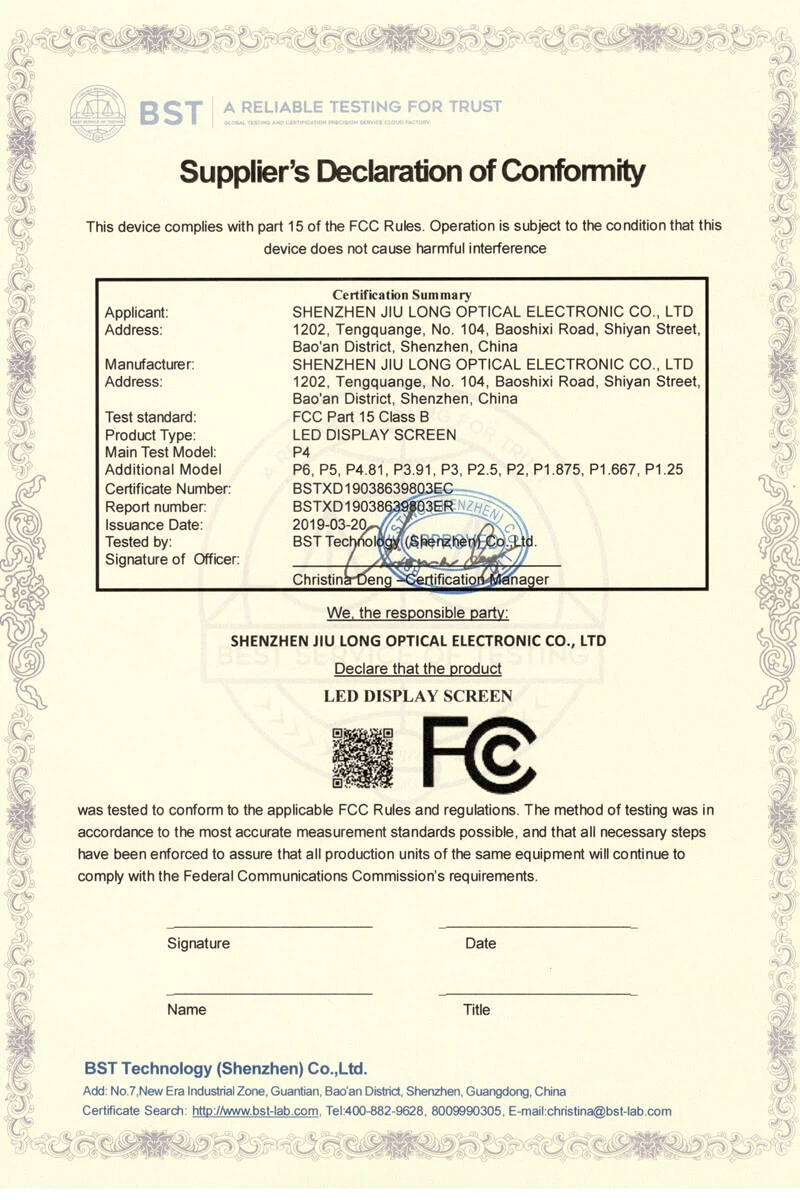
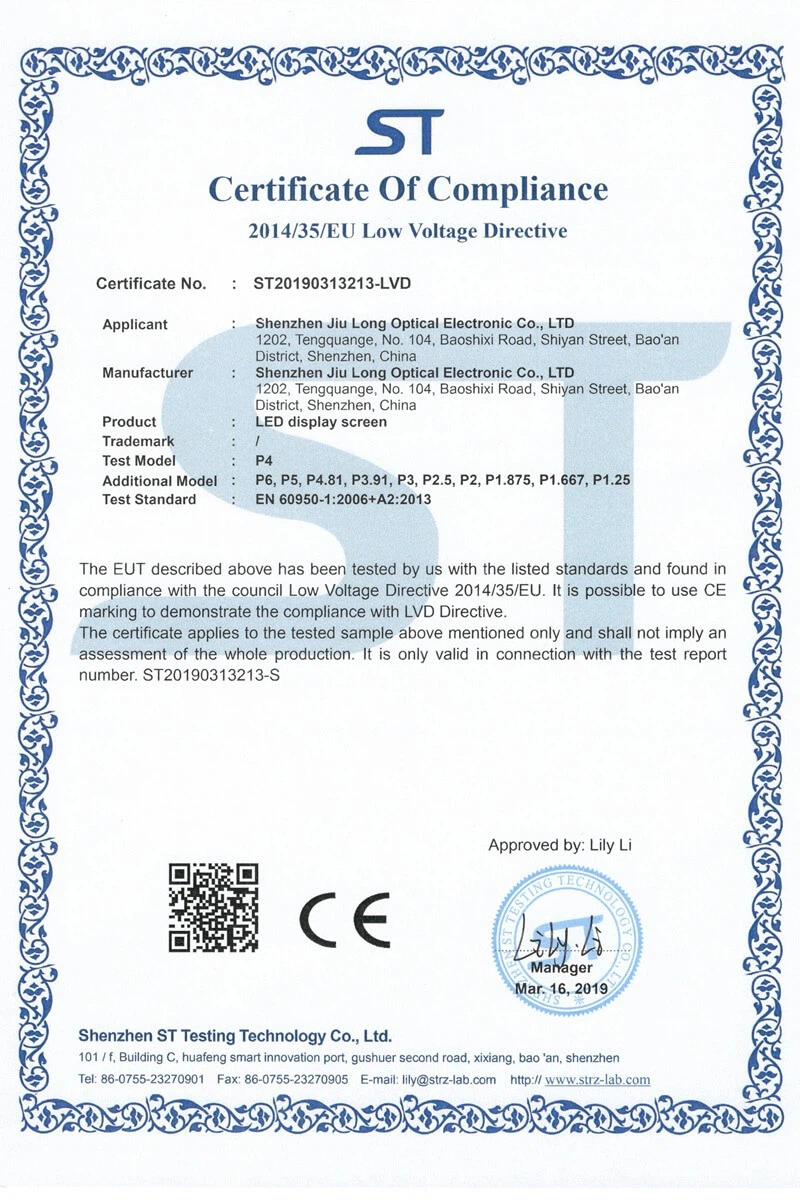
Various Certification:Our products have obtained 3C, CE, CB, IEC, TUV, FCC, RoHS, and other international safety regulations and hundreds of certificates.
Advanced Equipment & Professional Team:We have leading automated production equipment, professional management, R&D, production, and a complete sales and team of service. It provides favorable guarantees of product quality, scale, standardized production, and fast delivery.


What Is An Outdoor LED Display?
The outdoor LED display refers to the display used outdoors. The brightness of outdoor display is high, which is dozens of times higher than that of indoor LED display. In addition, the outdoor LED display also have good functions of waterproof and heat dissipation.
Key Specifications of Outdoor LED Displays
Pixel Spacing:Pixel pitch is the physical distance between two adjacent LED pixels on an LED display, usually expressed in millimeters (mm). The smaller the pixel pitch, the higher the resolution of the display and the clearer the image display.
Solve
The resolution represents the number of pixels in the horizontal and vertical directions of the LED display, usually expressed by the number of width pixels × the number of height pixels. Higher resolution means the display can render more detailed images and videos.
Brightness
Brightness refers to the luminous intensity of outdoor LED displays, usually expressed in nits. Outdoor LED displays need to have high brightness to ensure they are still clearly visible under direct sunlight.
Viewing Angle
Viewing angle refers to the maximum angle at which a viewer can see the display content horizontally and vertically. The wide viewing angle ensures that viewers can get a high-quality visual experience at different positions.
Refresh Rate
The refresh rate indicates the number of times the outdoor LED display is refreshed per second, usually in Hertz (Hz). Higher refresh rates reduce image flickering and provide smoother video playback.
Grayscale
Gray scale refers to the number of different brightness levels that an LED display can display. Higher gray levels can present more detailed images, especially for color images and video display effects.
Protection Level (IP Level)
The protection level indicates the dustproof and waterproof performance of the outdoor LED display, usually expressed in the form of IPXX. Outdoor LED displays need to have a high level of protection to adapt to various harsh climatic conditions.
Energy Consumption
Power consumption represents the energy consumed by the LED display when running, usually in watts (W). Low-power LED display is more energy-saving and environmentally friendly.
Screen Size
Screen size refers to the physical size of the outdoor LED display, usually expressed as width x height. Outdoor LED displays can be customized in different sizes.
Control System
The control system is a key part of managing LED displays, including signal processing, content management and remote monitoring. Modern outdoor LED displays often support network connections, allowing remote control and updating of content.
Types of LED Displays
LED screen displays can generally be divided into two groups: Indoor LED Display and Outdoor LED Display.
Indoor LED Display
An electronic display panel that uses light-emitting diodes (LEDs) to produce images and content is referred to as an indoor LED display. It is intended for use in indoor settings like retail stores, malls, theatres, and conference rooms. The LED display is made up of tiny LED modules that are arranged into a pixel matrix to produce vivid, high-resolution images. With their superior brightness, contrast, and colour reproduction, these displays guarantee clear, vibrant images. They are frequently utilised for interior visual enhancement, advertising, information display, and entertainment.
Outdoor LED Display
Large electronic display screens made specifically for outdoor use are called outdoor LED displays. It produces vivid and bright images by using light-emitting diodes (LEDs). These displays are strong, resilient, and waterproof against inclement weather, direct sunshine, and fluctuating temperatures. Outdoor LED displays are frequently utilised for events, information for the public, entertainment, and outdoor advertising. They are a useful medium for drawing attention and spreading messages in outdoor environments because of their great brightness, broad viewing angles, and capacity to display high-resolution content.
Trends of Outdoor LED Screen


Higher Screen Display Resolution
Outdoor LED screen usually has a large pixel pitch of 10mm above. However, with matured manufacturing processes and extensive R&D budget, we are getting fine pixel pitch as narrow as 2.5mm which is in the realm of indoor LED display territory. This enables outdoor LED screen to be visually sharper and have more detailed images. Such high-density outdoor LED screen provides new applications in areas with close viewing distance while requiring the robustness and waterproofing capability of outdoor LED screen.
3D Outdoor LED Screen
3D LED screen is a display technology that combines the use of 3D rendered animated videos and specially shaped LED screen display to create the illusion of three-dimensional images, all without the use of professional 3D glasses. The most popular shape employed for 3D LED screen is an L-shape, where there will be two sides of rectangular outdoor LED screens join together at around 90 degrees angle. Several key landmarks and malls around the world have employed such design for the outdoor LED screen. Normal 3D Outdoor LED screen uses flat module design with a right-angle joint that resulted in a black line that separates both sides of the display. Nowadays, new technology enables seamless outdoor LED screen by using a special design outdoor LED cabinet panel that wrap around the corner smoothly without any pixel loss.
Fully Front Accessible
Generic outdoor LED screen typically requires a service platform at the rear for the ease of service and maintenance. It is a general perception that outdoor LED screen display is thick and bulky due to the rear service requirement. However, some applications call for front accessibility and slim display screen design. In such cases, outdoor LED screen with fully front service capability is demanded. LED module, switching power supply unit and LED receiving card can be replaced from front by using simple tools in a true fully front accessible design of an outdoor LED screen. Therefore, the profile or the thickness of a front accessible outdoor LED screen can be as little as the LED cabinet panel thickness plus the single layer of mounting bracket. A fully front accessible outdoor LED screen can have a thickness ranging from 200-300mm, while a rear accessible outdoor LED screen have a thickness ranging from 750-900mm.
Lightweight Design
Traditional outdoor LED screen uses steel metal plate due to the ease of customization and low cost. The main drawback of using steel material is weight issue, which is a disadvantage for any weight sensitive application such as cantilever or hanging outdoor LED screen. A thicker and sturdier structure design is required to support a heavy outdoor LED screen, elevate the weight issue further. Therefore, one of the key trends of outdoor LED screen is to use lightweight material such as aluminium alloy, magnesium alloy or even carbon fibre. The most cost-effective option of the three options above is aluminium alloy, which allow for great weight saving over steel material and cheaper compared to magnesium alloy and carbon fibre.
Fan-less Operation
By using aluminium alloy extensively in the outdoor LED screen design, heat dissipation level increases over traditional steel material. This enables fan-less design, which reduces energy and noise level, and remove the inherited mechanical issue of ventilation fans. Hence, a fan-less outdoor LED screen is suitable for applications that require silent operation and green sustainability design. The only moving/mechanical part in an outdoor LED screen is ventilation fan, which has a definite lifespan and will breakdown over time. Fan-less outdoor LED screen eliminate this potential breakdown altogether.
Superior Weather Resistance
A traditional outdoor LED screen has an IP rating of IP65 for the front display area and IP43 for the rear area. The IP rating difference is because of the fact that traditional outdoor LED screen requires opening vents for the cooling ventilation fans to cool down the LED screen’s internals. The active ventilation design inherits another problem which is dust accumulation within the outdoor LED screen cabinet. Therefore, some manufacturers suggest to install an aluminium enclosure to the outdoor LED screen with air-conditioners to mitigate the problems above. This increases carbon footprint and operation costs because air-conditioners and fans require periodic service and maintenance.
Benefits of Outdoor LED Advertising Displays
Grabs The Attention and Leaves a Lasting Impression
With LED outdoor advertising displays, you can grab the attention of your audience and make them want to watch it. LED advertising displays are brighter and more colorful than traditional billboards, making them more interesting and engaging. And with the right content strategy, you can make your advertisement memorable. So, if you’re looking to really get your message out there, an LED billboard is the way to go!
Vibrant and Bright Colors
Outdoor LED advertising displays are known for their exceptional brightness levels. It ensures that content remains visible even in direct sunlight. In addition to the vivid and vibrant colors used in the LED displays, the advertisement has a greater visual appeal, which in turn makes it more memorable and engaging to all of the viewers.
Stand Tall in Any Weather
The amazing benefit of outdoor advertising LED displays is that they can easily endure any harsh weather conditions like rain, storm, or bright sun. Due to their weather resistance, LED displays are reliable, reducing downtime and maintenance costs, which can be significant concerns for outdoor advertising companies.
Flexible in Changing Content
You can change your LED display content anytime from anywhere with the central remote system. From static advertisements to a video, it can do it all! Using this dynamic capability, advertisers can adapt their marketing strategies, promote time-sensitive offers, and tailor messages for specific audiences. If you need to switch between different promotions during the day, respond to real-time events, or rotate seasonal campaigns, the ability to change content on the fly ensures that your advertising remains relevant and effective. A flexible marketing strategy allows businesses to stay responsive and agile to market trends and consumer preferences even in a fast-paced environment.
Real-Time Data Integration
Real-time data integration into outdoor LED advertising displays is revolutionary in the field of marketing. You can display real-time updates such as time-sensitive or weather-sensitive promotions, and event countdowns. This dynamic feature enables your campaigns to stay fresh and relevant, enticing viewers with the allure of timely information. Imagine showing LIVE match scores and running a promotion as soon as the score hits a specific mark. In the eyes of your audience, it not only attracts attention but also increases engagement, making your brand a beacon of importance.
Distinguishing Outdoor LED Displays from Indoor LED Displays
|
Feature |
Indoor LED Displays |
Outdoor LED Displays |
|
Environment |
Controlled environments, such as retail stores, offices, and homes |
Harsh environments, such as billboards, stadiums, and transportation systems |
|
Resolution |
Higher resolution for close viewing |
Lower resolution for viewing from a distance |
|
Brightness |
Less bright due to controlled lighting |
Brighter to compensate for sunlight |
|
Weatherproofing |
Not weatherproof |
Weatherproof and can withstand extreme temperatures |
|
Maintenance |
Less maintenance required |
More maintenance required due to exposure to the elements |
|
Cost |
Typically less expensive |
Typically more expensive |
|
Applications |
Retail displays, office signage, home theaters |
Billboards, stadium displays, transportation signage |
How to Save the LED Display If It Has Not Been Used for a Long Time?
After receiving the goods, the LED display has not been used for a long time or needs to be stored for a period of time after being used up. The storage method is as follows:
|
Indoor Fixed led display |
10%-65%RH ambient humidity |
The LED Cabinet is turned on at least once a day, and each time it is guaranteed to work normally for more than 4 hours. |
|
>65%RH ambient humidit/rainy season |
Dehumidify the environment in which the screen is used to ensure that the screen works normally for more than 8 hours a day. |
|
|
Outdoor Fixed led display |
10%-85%RH ambient humidity |
The LED Cabinet is turned on at least once a day, and each time it is guaranteed to work normally for more than 2 hours. |
|
>90%RH ambient humidit/rainy season |
Dehumidify the environment in which the screen is used to ensure that the screen works normally for more than 4 hours a day. |
Tips:
1)The above screen is lit, and it starts to age from low light, so as to avoid the short circuit of the led light/IC due to moisture, so that it does not work.
2) If conditions permit, it is recommended that the LED screen cabinet be stored in a flight case or a plywood case for sealed storage.
3)In each package, a dryer or moisture-absorbing bag of no less than 50g should be placed, and the dryer or moisture-absorbing bag should be inspected for failure regularly, and it is best to replace it every 2 months.
Maintaining outdoor LED screens will be a tough challenge as they are subject to failure from time to time due to bad weather such as heat, typhoons, rainstorm and lightning. Read on to get useful tips for maintaining outdoor LED screens in bad weather.
Equip With Heat Dissipation Equipment
Due to the large size, outdoor LED screens require a lot of power to operate, which in turn increases the amount of heat they release. If the heat dissipation issue with the LED screen cannot be resolved in a timely manner, it is likely to result in circuit short in the summer when the temperature is very high.
To aid with the equipment’s heat dissipation, LED screen manufacturers should aim to develop hollow shells and add an air conditioner or fan for their LED displays. As for business owners, you should insist on having the LED display screens installed in a place that has good air permeability. If necessary, you can additionally add heat-dissipation apparatus to the exterior.
Add Lightning Rods and Lightning Protectors
Although the outdoor LED displays have excellent waterproof performance, prolonged exposure to thunderstorms can easily destroy the housing screen and lead to circuit breakers and other issues. In serious cases, it might potentially start a fire. Therefore, lightning protection for outdoor LED screens is essential.
1)Installing lightning rods and grounding wires on the support structure of the outdoor LED display screens can effectively prevent direct lightning strikes. In general, grounding resistance values must be fewer than 10 ohms; if they are higher, you must create an additional artificial grounding network.
2)Lightning current can be efficiently stopped on the power line by a single-phase or three-phase power lightning protector. It is important to note that the cross-sectional area of the phase line should be larger than 10 square millimeters and the cross-sectional area of the grounding wires should be larger than 16 square millimeters.
3)Lightning current can be efficiently stopped on a signal line with a signal lightning arrester. The system’s signal interface determines the signal lightning arrester. If the interface is a network cable, a network signal lightning arrester is installed; if it is a serial interface, a DB9 interface lightning arrester is installed. It is worth noting that the cross-sectional area of the grounding wires cannot be less than 1.5 square millimeters.
Our Certification




Frequently Asked Questions about Outdoor LED Display
Q: What is the Indoor LED Display?
Q: What is the difference between indoor and outdoor LED displays?
Q: What are LED displays used for?
Q: What are the possible installation methods for an indoor LED screen?
1)Wall-mounted:LED display wall-mounted. Suitable for 10 square meters of the indoor LED display screen, wall requirements for solid walls, with a specific load-bearing capacity.
2)Suspension:Suspended from the ceiling by special steel beams. People usually use them in busy places because the LED display can be seen in crowded or distant sites.
3)Independent:Indoor LED monitors can also be installed on the floor. Your Indoor LED display vendor will install a sturdy bracket at the bottom of the screen to make it stand up. Suitable for indoor small LED display screen.
4)Embedded:In the screen of the hole wall, the display will be embedded in the screen aperture and screen size. Suitable for the occasion of small spacing and small screen area.
Q: What is the Color Temperature and why is it important?
Low levels of color’s temperature correspond to color’s tones stretching out to the red, while high levels correspond to color’s tones stretching out to the blue. In LED maxi-screen is fundamental to keep constant this measure to visualize high quality and naturalness pictures..
Q: What is the Contrast level of a led billboard?
Q: What is the IP rate (acronym of ingress protection) and what does it measure?
Our electronic billboards guarantee a IP65, the highest reachable in the LED visualization field.
Q: What is the resolution of a led display?
For example a 20 mm pitch screen has a resolution of 2304 pixels: this measure is obtained dividing the total length of a single module (975 mm) by the pixel pitch (in this case 20 mm) resulting in the number of pixels on a single line: 975:20 = 48 pixels. Multiplying the number of pixels present on a single line by the total number of lines the result is the total number of pixels present on the screen’s surface, also called Resolution. In our example, 48 x 48 = 2304 pixel in total. Given this formula, it is possible to calculate that a 30 mm pitch screen has a resolution of 1024 pixel per module, while a 10 mm pitch screen has a resolution of 9216 pixels per module. It is important to notice that reducing of only few millimeters the pixel pitch, the LED density (and therefore the resolution) increase exponentially.
Remember: Smaller is the pitch » Shorter is the minimum viewing distance » Higher is the total number of pixels present on the LED video wall » Higher is the quality image » Higher is the screen’s cost per area.
Q: What is the viewing angle of a led wall?
For example, a LED screen with 5000 NIT frontal luminosity (NIT = millicandels/sq) has a visibility angle equal to the angle by which the brightness is reduced to 2500 NIT. This visibility angle can vary depending on the LED and the technical features of the display.
Q: Is led better than lcd?
Q: Is an led screen worth it?
Q: What is the waterproof led screen?
Compared with indoor displays, semi-outdoor or outdoor displays may be affected by weather such as rain due to their outdoor environment.
Therefore, they must have certain waterproof capabilities and reach the corresponding waterproof level to ensure the normal operation of electronic equipment. Indoor displays do not need to consider the waterproof level. Most of their protection levels are IP54, which has certain dust-proof and moisture-proof capabilities.
The protection levels of outdoor LED billboards include IP65, IP66, IP67, etc.
Q: How do outdoor led display screens work?
Q: What are the benefits of outdoor LED display screens?
Q: Are outdoor LED display screens suitable for all weather conditions?
As one of the leading outdoor LED display manufacturers and suppliers in China, we warmly welcome you to buy customized outdoor LED display from our factory. All OEM&ODM products are with high quality and competitive price. Contact us for quotation.
Outdoor LED Digital Video Wall, video wall manufacturers, outdoor display screen