


Commercial LED Display
Your Professional Commercial LED Display Manufacturer!
Experienced Company:Shenzhen JIulong Optoelectronics Co., Ltd. was founded in 2012. We are a high-tech enterprise integrating the development, production, sales, and engineering services of LED displays. Our main products include small space LED and LED Screens for rent.
High Quality:Jiulong Optoelectronics LED display screen has reliable quality and realistic images and has won customers at home and abroad. Our products are exported to more than 160 countries and regions in America, Europe, Asia, and Australia, with successful cases all over the world.
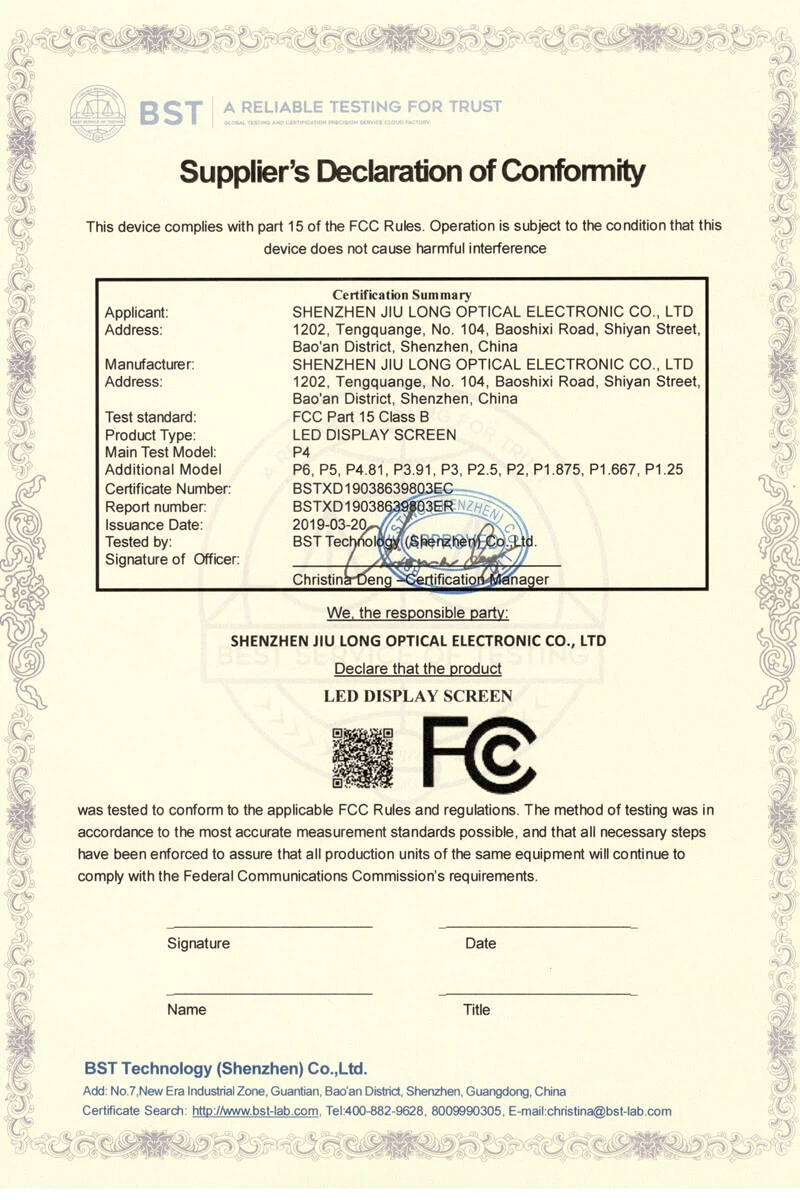
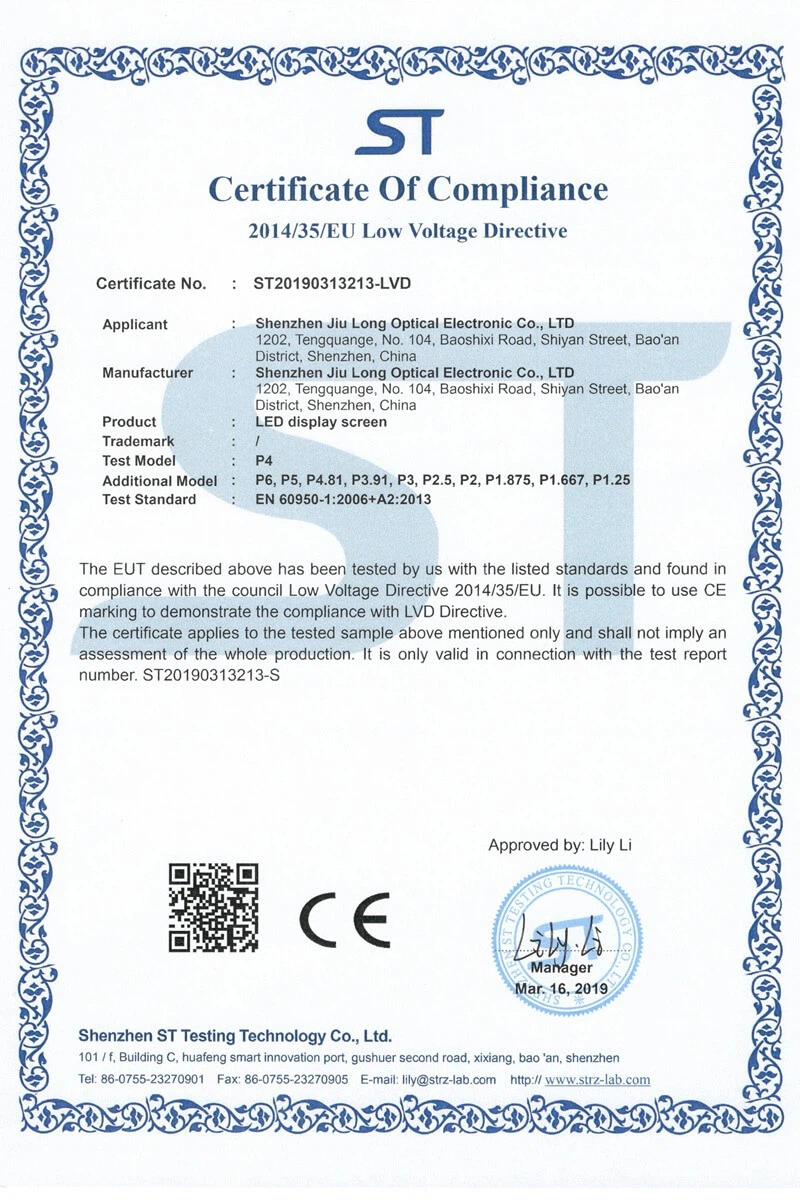
Various Certification:Our products have obtained 3C, CE, CB, IEC, TUV, FCC, RoHS, and other international safety regulations and hundreds of certificates.
Advanced Equipment & Professional Team:We have leading automated production equipment, professional management, R&D, production, and a complete sales and team of service. It provides favorable guarantees of product quality, scale, standardized production, and fast delivery.


What Is A Commercial LED Display?
Commercial displays are designed in a way that they can operate in various environment. They are built to serve enterprises and businesses regardless of their niche. These displays also work well for commercial display. Made strictly for commercial purposes, these displays have potential to work in environments where there is risk of wear and tear without getting damaged. They can withstand long hours and can work in harsh setups such as rain, knocking while installation, and dust etc.
Commercial led displays also work really well in professional setups such as corporate events or large conferences. These LEDs are created with audience in mind. Depending on the application and location of the LED display, you can choose the angle and resolution of your led. The main purpose of these led displays is to get the message across. More often than not, commercial displays aren’t used for any entertainment.
Long Operation Hours
The most important feature of commercial LED displays is that they can withstand long operating hours without any risk of getting damaged. Usually, commercial displays are designed to run 24/7 or at least more than 12 hours.
Brightness Varying
Commercial displays have a variety of options for brightness. They can be used in any setting with any lighting. This makes their visuals highly appealing to the viewers and makes it easy to get the message across to the audience.
Higher Operating Temperature Threshold
Since commercial LED displays operate for long hours, they are at risk of heating up. However, they are built in a way that they can withstand high operating temperatures. Their heat dissipation features prevent the display from heating up.
Landscape and Portrait Mode
Commercial LED displays usually have both landscape and portrait modes. Depending on your usage. You can choose any mode you prefer and get the best experience of the display.
Better Manufacturer Warranty
Commercial LED displays usually have a longer warranty. We will give you better service and offer you a long warranty for your display.
Types of LED Displays
There are numerous LED display panel types on offer. Some of the more common configurations include segmented displays, dot matrices, alphanumeric and light bar versions.
The sections below provide a closer look at the differences between these types of LED screens and outline when a particular model or style might prove more useful or economical.
Dot Matrix LED Display
LED dot matrix displays can be considered as the next logical step up from 16-segment alphanumeric arrangements. In a typical dot matrix LED display, the clustering of individual diodes is dense, while the dots (LEDs) are typically arranged in a rectangular grid that is wider than it is tall.
The basic operating principle of an LED matrix display is straightforward. By turning individual lights on or off in programmable sequences, full alphanumeric displays can be rendered as a matrix in reasonable detail. The precise level of detail achievable will depend on the density of the LED array and the resolution of the dot matrix. This may also impact the digit height.
7-Segment LED Display
An LED 7-segment display is one in which any numeral can be laid out using an arrangement of seven separate LED segments. The individual diodes in a 7-segment display are arranged in a rough figure-eight system so that each LED segment can be individually illuminated (or left unlit), allowing the grouping to display any digit from 0-9.
Seven-segment display arrangements are sometimes abbreviated to SSDs and can also be referred to as seven-segment indicators. They are among the most common LED display configurations used for providing simple numerical readouts on a broad range of device types.
Seven-segment displays are generally limited to showing numerals. They are not considered especially suitable for lettering, as the minimal number of segments in each LED display makes it difficult to render sufficiently readable characters.
14-Segment LED Display
A 14-segment LED display takes much the same basic format as the 7-segment version but uses double the number of diodes. They are arranged in the familiar figure-eight shape, but with the addition of diagonal diodes crossing through the centre point. This configuration is also known as a Union Jack or starburst LED display.
The increased LED count allows for a significantly more detailed display, meaning that full alphanumeric readouts become much more feasible. However, even with fourteen segment displays, some letters in the alphabet remain difficult to render with great clarity.
In the mid-1980s, pinball machines and other arcade games were among the first everyday devices to help popularise the LED 14-segment display. In some design applications, the format is still used to achieve a stylised retro aesthetic. 14-segment displays remain a popular option for many device types.
16-Segment LED Display
As with 7-segment and 14-segment displays, a 16-segment LED display also conforms to the same basic figure-eight module arrangement. However, an additional pair of diodes are added by splitting both the upper and lower horizontal segments into two.
This allows for yet more detail in the graphical rendering of numbers and letters. It is generally deemed sufficient for reasonably full alphanumeric LED display readouts on devices where a more intricate dot matrix LED display is impractical or unnecessary.
Major Applications and Use Cases of Large Format LED Displays
There are a lot of cases where large-format LED screens come in especially handy. Now, don’t get it wrong – small screens might also manage to get the job done in these regards. But, when you consider the advantage that a massive size gives, you’d find that the former tends to just be better.


Showcasing Anything With Digital Signage
Everywhere you look, there’s some form of digital signage trying to grab your attention. It could be retail stores, transportation locations, shopping malls, or anywhere. With large format screens, you can ensure optimal visibility for your signage and easily pass your message across.
Ads In Outdoor Spaces
From digital posters to billboards and more, large-format LED screens are beyond perfect for outdoor advertising. You can share static or dynamic content, so they’re quite flexible.
Engagement At Large Arenas
We see large LED screens working as scoreboards for sports events, ad boards for public spaces, and more. They help perform the dual role of engagement and information dissemination, and they do that incredibly well.
Supercharging Background Work At Control Rooms
Data centers, security rooms, and many more control centers make use of the expanded views that they get with large format LED screens to ensure proper visibility for their outdoor systems – alarms, security cameras, and more.
They Work In Educational Settings Too
While this is a functionality that doesn’t get much exploration, large LED screens can also work for campus signage and classroom displays to facilitate interactive learning and information sharing.
Corporate & Hospitality Functionalities
Thanks to their size, large LED display screens are perfect for both corporate and hospitality locations. In the former, they can be placed in lobbies and meeting rooms for displaying information, while their use in public spaces and bespoke conference rooms makes them perfect for the latter.
An Innovation In The Broadcasting Space
Today’s broadcast industry professionals use large LED screens to effect virtual backgrounds, green screens, and video walls that aid in flexible visual presentations.
Benefits of Using LED Display Screen
Higher Brightness
The brightness of LED display is higher than LCD display. Even under direct sunlight, it can display the images and videos clearly, while LCD display is more susceptible to ambient light.
The brightness level of LED screen ranges from hundreds to thousands, which can be adjusted accordingly to fit the environment.
Wider Viewing Angle
LED display has a wider viewing angle which can up to 160°to ensure people can see the images clearly from different angles. However, for LCD display, viewing angle is more limited and narrower.
High Contrast
The contrast ratio is much higher than LCD display, and the high contrast will increase the visibility under different conditions. For example, no matter in indoor or outdoor with strong daytime sunlight, commercial LED screen can show picture details greatly.
Energy-Consumption
The ratio is about 10:1 when comes to power consumption of LCD and LED screen. The lower power consumption can save money for users and prolong service life.
Customized Sizes and Shapes
For LED displays, it is easy to customize sizes and shapes as the unique manufacture technics. While for LCD screens, it is not so easy to achieve.
For instance, LED cabinets can be installed as LED video wall (refer to display with huge size), and theoretically, the size can be unlimited. This feature allows LED screens seamless, no bezels appearance, whereas LCD display screens inevitably have bezels on the surface, and can not achieve large display.
Service Life
The working life of commercial LED signage is much longer than that of LCD. Basically, the lifespan of an commercial LED display can reach 50,000 hours while that of LCD screen can only reach 30,000 hours. That means, if you use them 10 hours a day, the working life will be 15 years and 8 years respectively.
How Are LED Displays Manufactured?
Have you ever wondered how to make a LED display? Do you know how the large dynamic video-playing electronic LED displays you see on the main streets of your city are made? If you’re curious or thinking about buying an LED display, you might be wondering: How are LED displays made? Bibi Led, as a leading brand LED display manufacturer in Shenzhen, we would like to tell you every detail of the LED display production process to ensure that you can better understand the LED display.
LED Lamp Baking
If the SMD lamp beads are not baked, there will be many dead lights after application. Therefore, in order to better ensure that the lamp beads can be used normally, they are generally baked before use.
PCB SMT
IC SMT needs to brush solder paste first, then paste IC, resistors, capacitors, power sockets, and signal sockets, and reinforce them in reflow soldering.
LED SMT
The lamp bead surface patch also needs to be brushed with solder paste first, then patched on the SMT machine, and finally reflowed.
Light on Test
This is the first lighting test, if there is a problem, it will be repaired and then proceed to the next step
Brush Three Anti-Paint
The three-proof paint has good high and low temperature resistance; after curing, it forms a transparent protective film, which has excellent insulation, moisture-proof, anti-leakage, shock-proof, dust-proof, anti-corrosion, anti-aging, corona resistance and other properties.
Screw (Bottom Case)
Secure the bottom case and PCB with screws.
Glue (Outdoor Led Modules Only)
The glue is used to waterproof the surface of the outdoor LED display. After the glue is poured, it needs to be prevented from drying on a horizontal shelf.
Screw (Mask)
Secure the mask with screws.
LED Module Aging
After the LED module is produced, it will be aged for 6 to 12 hours to ensure that there is no problem before proceeding to the next step.
LED Cabinet Assemble
Assemble the LED module, power supply, receiving card, and cabinet together.
Full LED Screen Aging
When the LED cabinet is assembled, build the entire LED display and conduct an aging test for at least 24 hours.
Package
After the LED display test is completed, package and deliver.
Steps To Clean LED Screens
Turn Off the Screen
LED screens generate some heat when working, especially during long uptimes. So, before cleaning your LED screen, turn it off and unplug it from the power source to allow it to cool.
By doing so, accumulated static electricity will dissipate and, with it, a sizable amount of dust. You’ll then have an easier time completing the remaining steps.
Disconnecting the screen from its power source also eliminates the risk of electrocution and short-circuiting internal components.
Clean Again With Wet(Dampened) Cleaning Apparatus
This step will remove the dirt and smudges that remain after completing the procedure outlined above in step#2.
Dampen the cleaning cloth with your preferred cleaning agent. You don’t want to use a sopping wet cloth. Consider spraying your cleaning agent on the cleaning cloth. You can also dip the latter in the former as long as you wring out any excess liquid.
With the newly dampened cloth, gently wipe down the screen, paying particular attention to any particularly smudged areas.
Repeat the process until the display screen is completely free of dirt or debris.
Dry Clean With a Dry Microfiber Cloth, Bristle Brush, Or Vacuum Cleaner
The next step is to dry-clean your screen with cleaning supplies. You can use a microfiber (cleaning cloth), a blow dryer, or bristle brushes to complete this step.
Using a microfiber cloth, gently rub the screen in concentric circular motions to safely remove any debris.
If you’re using a bristle brush to remove debris, brush the display horizontally or vertically. Compared to diagonal or circular brushing motions, this reduces the risk of dislodging individual LED pixels.
Use the vacuum cleaner to remove dust from the edge panel and other spots the cleaning cloth or bristled brush cannot reach.
Air Dry Or Blow Dry
You can dry the LED display naturally under the right conditions. However, in cold or humid weather, we recommend you blow dry the screen. Don’t forget to use appropriate wind power to avoid damaging the screen.
Stylish and Cutting-edge Commercial LED Display Technology
3D LED Display
3D LED Display is a perfection solution for branding and promotion of your business as it provides a long lasting influence on the passerby. The hyper realistic 3D effect can enhance product insight and brand impact by creating visual effects that is aesthetically pleasing and more impactful. It is used in various settings including retail promotions, exhibition displays and outdoor advertising.
Flexible LED Display
These commercial LED screen can be shaped into various creative and unique designs like curved LED screens, pillar screens, triangular screens and spherical screens. This LED Screen helps businesses to transform their screen into any attractive or irregular shapes for engaging the audiences and customers more effectively.
Transparent LED
This is the most popular and attractive way to display the business message of the transparent LED display screens. This display technology makes use of transparent material for creating vibrant and vivid image for engaging the audiences. It allows cost effective way of conveying business message as the commercial LED screen price is affordable for businesses.
Guide to Choosing the Best Commercial Display
In the rapidly evolving landscape of digital marketing and communications, commercial displays stand out as visual centrepieces, catching eyes and conveying messages powerfully. But with myriad options available, how can you make the right choice?
Understand Your Goals
Identifying your primary objectives – be it branding, advertising, or information dissemination – can significantly narrow down your options. Tailor your choice based on your target audience's demographics and your content's nature.
Indoor or Outdoor Deployment
An outdoor setting necessitates weather-proof and sun-readable displays, whereas indoor environments offer more flexibility. Ensure that the commercial display you select is suited for its intended environment.
Size and Resolution Matters
Ensure your display is visible and readable from the intended viewing distance. For large venues, bigger screens with higher resolutions, such as 4K or even 8K, deliver clearer images.
Content Management System (CMS)
Your CMS should be intuitive and cater to your specific needs. Look for features like remote updates, scheduling, and multi-screen management capabilities.
Connectivity Options
Modern commercial displays should support HDMI, USB, and network-based inputs. Wi-Fi and cloud integration can provide added flexibility for content updates.
Interactivity Features
Touchscreen capabilities, QR code integration, and NFC support can enhance user engagement, offering interactive experiences.
Durability and Lifespan
Commercial displays, especially those running 24/7, need to be durable. Look for models designed for extended use, which reduces the risk of issues like burn-ins.
Scalability
Future-proof your investment by choosing displays that can seamlessly integrate with expanding systems or newer technologies.
Consider the Budget
While it's tempting to go for the cheapest option, it's crucial to consider the total cost of ownership, which includes maintenance, software updates, and potential expansion needs.
Vendor Reputation and Support
Opt for trusted brands offering robust customer support. Regular software updates, warranties, and training resources can be invaluable in the long run.
Our Certification




Frequently Asked Questions about Commercial LED Display
Q: What is a commercial display?
Q: How commercial led display is different from consumer led displays?
Similarly, commercial led displays may be placed at different angles than consumer ones. Consumer displays are usually placed in lounge or bedroom, but with commercial led displays, you may want to install it on height, or on a distance. This is why distance and angles of commercial displays vary from consumer ones. Commercial led displays are also designed with heat dissipation features to prevent the display from heating up.
Q: What’s the difference between LCD and LED?
1)the complete name of the LCD screen could also be a liquid display. it’s one light , which is refracted layer by layer to form an image .the complete name of the LED screen is light emitting diodes. After being energized, electricity is directly converted into light energy. Each pixel consists of three colored beads of red, green, and blue.Which color is brighter and which LED lights increase the brightness. Therefore, it are often interpreted as an “addition”.
2)LED brightness has more advantages: the response speed of each element of the LED display is 1000 times that of the LCD, therefore the brightness range is wider.the sunshine of the LCD display is filtered through the layer. The brightness isn’t nearly as good because the previous . LED viewing angle is wider: LED screen can provide a viewing angle of 160 degrees, and should be viewed in various positions. The LCD screen is difficult to the touch . LEDs are brighter and brighter: LED display screens can emit light by themselves, each pixel is three-color light, and thus the display effect is fuller.
3)The LCD display features a backlight layer, the sunshine goes to be refracted, therefore the color isn’t as bright because the LED screen often seamlessly spliced, more beautiful. The LCD screen has been spliced, but there are gaps. There are black lines visually, which may affect the viewing effect.
Q: How does LED display system work?
Q: What is the structure of LED display?
Q: What material is LED display?
The main semiconductor materials used to manufacture LEDs are: Indium gallium nitride (InGaN): blue, green and ultraviolet high-brightness LEDs. Aluminum gallium indium phosphide (AlGaInP): yellow, orange and red high-brightness LEDs. Aluminum gallium arsenide (AlGaAs): red and infrared LEDs.
Q: What is a LED display panel?
Q: What is the difference between flat LCD panel display and LED display?
Q: Why use LED displays outdoor?
Q: Can an LED display be replaced?
Q: What the life of an LED display?
Q: How do you clean LED walls?
Q: What can be called a commercial LED screen?
Q: What is a led?
Q:What is a pixel?
Q: What is the 16 bit technology?
As one of the leading commercial LED display manufacturers and suppliers in China, we warmly welcome you to buy customized commercial LED display from our factory. All OEM&ODM products are with high quality and competitive price. Contact us for quotation.
Small Pitch LED Screen, Full Color Digital Signage BillBoard, led video board