


Small Pitch LED Screen
Your Professional Small Pitch LED Screen Manufacturer!
Experienced Company:Shenzhen JIulong Optoelectronics Co., Ltd. was founded in 2012. We are a high-tech enterprise integrating the development, production, sales, and engineering services of LED displays. Our main products include small space LED and LED Screens for rent.
High Quality:Jiulong Optoelectronics LED display screen has reliable quality and realistic images and has won customers at home and abroad. Our products are exported to more than 160 countries and regions in America, Europe, Asia, and Australia, with successful cases all over the world.
Various Certification:Our products have obtained 3C, CE, CB, IEC, TUV, FCC, RoHS, and other international safety regulations and hundreds of certificates.
Advanced Equipment & Professional Team:We have leading automated production equipment, professional management, R&D, production, and a complete sales and team of service. It provides favorable guarantees of product quality, scale, standardized production, and fast delivery.


What Is A Small Pitch LED Screen?
A small pixel pitch LED screen display, also known as a narrow or fine pixel pitch LED display, refers to an LED display with a pixel pitch lower than 2.5mm. This technology is rapidly advancing, with pixel pitches as low as 1.56mm, 1.2mm and 0.9mm already available and even lower pitches on the horizon. Small pixel pitch LED displays are primarily used indoors and find applications in conference meeting rooms, broadcasting TV stations, military control rooms, airports, subways and more. With their high-quality 4K display capability, LED video walls have gained significant popularity.
Features of Small Pitch LED Screen
High-Definition Display:The high-definition display of the small spacing LED display is like a delicate oil painting, and every stroke is clearly visible, just like every detail carefully drawn by the painter. Whether it is distant mountains, nearby characters, or tiny textures, they can be accurately presented.
Ultra-Light and Thin, Seamless Stitching:The ultra-light and thin design of the small pixel pitch LED display is like the revolution of mobile phones from bricks to paper, which is light, beautiful, and convenient to carry and install. Seamless stitching is like the perfect stitching in a jigsaw puzzle game. Each screen is like a well-made jigsaw puzzle block, which is tightly connected to form a complete picture. No matter from which angle you look at it, you can’t see any gap.
Super-Large Perspective:Just like watching a movie in the cinema, no matter where you sit, you can clearly see the picture on the screen, and so is the super-large viewing angle of the small pixel pitch LED display. No matter which angle you stand from, you can get a clear and vivid visual experience, just like on the scene.
Good Heat Dissipation, Quiet and Noise-Free:Just like a high-end car, the small pixel pitch LED display can keep calm while running efficiently without noise due to overheating. Its cooling system is like the cooling system of a car, which ensures that the machine remains stable during long-term operation and provides you with a quiet and comfortable working environment.
Types of LED Technology
Edge LED
With this type of screen, the light-emitting diodes are distributed along the entire edge of the screen, either completely surrounding it or occupying only one of the four ends. However, the presence of light reflectors ensures homogeneous illumination over the entire surface of the screen, although not with as much precision as in Full LED monitors. Of course: Edge LED screens are thinner than the latter.
Full LED with Screen
The distribution of diodes in Full LED screens is already used by many televisions. In this case, the LEDs intended for backlighting are hidden behind the LCD screen, encompassing it in its entirety. Hence, the feedback it offers is more homogeneous than that of the Edge LED. Of course: as a disadvantage compared to this latest technology, it should be noted that the thickness of the screen will be somewhat greater. On the other hand, displays that use RGB LEDs (that is, with red, green and blue primary colours) provide an even greater colour palette.
Direct LED
This system is not used much, since the image quality it provides is inferior to the previous cases. In addition, it requires televisions to be thicker, given the distribution of LED lighting. Direct LED screens have the diodes located on the back. This characteristic is very similar to that of the Full LED, but with a difference: the number of LEDs is clearly less, so the lighting is not as good. Although they represent an improvement in brightness compared to the Edge LED, they do not offer the performance of the Full LED. Likewise, they do not usually have the local dimming option (we will see what it consists of below).
Edge LED with Local Dimming
Each LED diode has an artificial intelligence that allows it to turn on and off automatically. In other words, the diodes are illuminated by sectors, depending on the information received from the images broadcast and from the digital processor of the board. This particularity means that, if a program or movie has been recorded under excessive or insufficient light conditions, the Edge LED with the local dimming function can correct this problem, thus offering images of great realism. However, there may be viewers who prefer to do without this automatic setting, especially if they are going to watch a film noir, horror or expressly shot in dark or night environments. When this occurs, local dimming can be disabled.
Full LED with Local Dimming
The Edge LED technology screen has the same advantages when it comes to correcting lighting problems during broadcast. In this case, the light is even more homogeneous, and although, as mentioned, the screen tends to be thicker.
OLED
It is based on the use of organic light-emitting diodes (in English, organic light-emitting diode). This type of diode has an electroluminescent layer made up of a film of organic components. These react to a certain electrical stimulation, generating and emitting light by themselves. OLED does not require a backlight.
Applications of Fine Pixel Pitch LED Display
The significant advantage of the small pixel pitch LED display is that screen can be seamlessly spliced, and the size can be expanded infinitely in theory. Moreover, the installation mode is flexible and diverse and operation and maintenance cost is low. The application of LED small pitch technology in the security monitoring market largely ensures the timeliness and accuracy of security monitoring.
From the perspective of future demand, especially the demand for remote office that has continued to accelerate since the epidemic, larger images and better bright image quality effects are almost a must for the conference room display market. In the future, the demand for immersive conference rooms will become the main competitive advantage of small pitch LEDs relying on large screens and high brightness to enter the conference room scene.
The technical index requirements for the color temperature, brightness, grayscale, viewing angle, contrast ratio and refresh rate of the display panel in the studio are quite demanding. Small pitch screen can easily meet the application of such scenes in all technical indicators. And it is more excellent in contrast and color. So the broadcasting application will be an important territory of HD LED.
New and better technologies make our gaming experience even more exciting. One such technology is virtual reality. For a great experience, everything from display to sound must be of high quality when playing in an interactive gaming system. The fine pixel pitch LED display helps achieve the exact purpose of a high-quality display, making our interactive gaming experience better.
In the traffic command and control center, the small pitch LED display can play the role of a monitoring display platform. The split-screen function of the LED display processor can effectively manage and supervise each traffic monitoring area and road section in real time, which is inseparable from the feature of small pitch LED display supporting 7*24 hours of uninterrupted operation.
Advantages of Small pitch LED displays
Seamless Splicing
Splicing large screen display technology in the maximum to meet customer needs can not avoid the impact of physical border, even if the ultra-narrow side DID professional LCD screen, there is still a very obvious stitching, only the LED display makes the stitching after the splicing to achieve seamless requirements, high-density small spacing LED seamless splicing advantages can be highlighted.


High Brightness Is Intelligently Adjustable
LED screen itself is high brightness, in order to meet the strong light environment and dark light environment to give the viewer a comfortable viewing effect, to avoid visual fatigue, can be combined with the light sense system for brightness adjustment.
Better Color Performance With High Gray Scale
Even if the grayscale performance of the display is almost perfect at low brightness, and the picture layering and vividness of the display are higher than those of traditional displays, the image details can be more detailed without information loss.


High Contrast Faster Response Speed and High Refresh Rate
The number of times the electron beam repeatedly scans the image on the screen, the higher the number of scans, the higher the refresh rate, and the better the stability of the displayed image (picture). The lower the refresh rate, the more the image flashes and shakes, and the faster the eyes strain. LED small spacing screen under high refresh, the ingestion picture is stable, no ripple black screen, the image edge is clear, and the real information of the image is accurately restored.
Color Restoration and Naturalization
Using the international leading point-by-point correction technology, the use of LED luminous principle, complete retention of color authenticity, to avoid other display technologies such as backlight projection materials, light running path caused by color loss and deviation, to achieve the true sense of color reproduction.


Three-Dimensional Visual Experience
When customers choose to use the 3D playback mode, the splicing wall will present a shocking high-definition image, whether it is live TV, exhibition display, or digital advertising, it can fully interpret the wonderful visuals, so that the audience can enjoy an extraordinary visual experience.
Technical Parameter of Our Small Pitch LED Display
|
Pixel Pitch |
P0.78125 |
P0.9375 |
P1.25 |
P1.5625 |
P1.875 |
|
Physical density(Dot/sqm) |
1638400 |
1137778 |
640000 |
409600 |
284444 |
|
Module size(mm) |
150X168.75 |
300X168.75 |
300X168.75 |
300X168.75 |
300X168.75 |
|
Panel Dimension (WXHXD/mm) |
600X337.5X27.5 |
600X337.5X27.5 |
600X337.5X27.5 |
600X337.5X27.5 |
600X337.5X27.5 |
|
Panel Resolution |
768X512 |
640X360 |
480X270 |
384X216 |
320X180 |
|
Module QTY(WXH) |
4X2 |
2X2 |
2X2 |
2X2 |
2X2 |
|
Panel weight(kg) |
4.5 |
4.5 |
4.5 |
4.5 |
4.5 |
|
Maintenance Mode |
Front maintenance |
Front maintenance |
Front maintenance |
Front maintenance |
Front maintenance |
|
Cabinet Material |
Die-casting aluminum |
Die-casting aluminum |
Die-casting aluminum |
Die-casting aluminum |
Die-casting aluminum |
|
Brightness Carlibration |
have |
have |
have |
have |
have |
|
Brightness(Nits) |
≥600 |
≥600 |
≥600 |
≥600 |
≥600 |
|
Color temperature(K) |
1000-18500 Optional |
1000-18500 Optional |
1000-18500 Optional |
1000-18500 Optional |
1000-18500 Optional |
|
Viewing angle(V/H) |
170°/170° |
170°/170° |
170°/170° |
170°/170° |
170°/170° |
|
Brightness/Color uniformity |
≥99.8% |
≥99.8% |
≥99.8% |
≥99.8% |
≥99.8% |
|
Contrast ratio |
10000 : 1 |
10000 : 1 |
10000 : 1 |
10000 : 1 |
10000 : 1 |
|
Frame frequency |
50/60 |
50/60 |
50/60 |
50/60 |
50/60 |
|
Drive mode |
1/48 scan |
1/46 scan |
1/45 scan |
1/48 scan |
1/45 scan |
|
Grey level |
16bit |
16bit |
16bit |
16bit |
16bit |
|
Refresh rate(Hz) |
3840 |
3840 |
3840 |
3840 |
3840 |
|
Max. power consumption(W/sqm) |
350 |
350 |
350 |
350 |
350 |
|
Avg. power consumption(W/sqm) |
100 |
100 |
100 |
100 |
100 |
|
Protection level |
IP31 |
IP31 |
IP31 |
IP31 |
IP31 |
|
Power input |
AC90-264V,47-63Hz |
||||
|
Wroking temperature/humidity(℃/RH) |
-20~60℃/10%~85% |
||||
|
Storage temperature/humidity(℃/RH) |
-20~60℃/10%~85% |
||||
How to Install Small Pitch LED Screens?
For different installation methods, the detailed requirements for installation will be a little different. The main installation methods are : Wall-hanging, Embedded, and Floor-standing.
Wall-hanging and Embedded
These two installation methods of the LED Display are Wall-mounted installation, which means that there is no maintenance space behind the LED Display, and the cabinet needs to support Full front service.
When installing, we need to fix the structure on the wall firstly, then install the cabinet on the structure. The following points need special attention:
1) Steel structure construction
The welding process of the steel structure will affect the flatness of the screen installation directly. In order to avoid the blind angle of the viewing angle caused by protrusions or depressions, please find a professional welding master to make the structure according to the CAD drawing we provide structure.
2) Lightning protection and anti-static treatment
Keep the LED display body and the shell well-grounded, and the grounding resistance is less than 3 ohms. The static electricity generated during the installation process and the large current caused by thunder and lightning can be discharged in time, and avoid the failure of LED and IC caused by static electricity even the case of a damaged situation.
3) Installation of ventilation equipment
When the display screen is working, a certain amount of heat is generated. If the ambient temperature is too high and the heat dissipation is poor, the integrated circuit may not work properly or even be burned, which will make the display system unable to work normally.
Floor-standing
In addition to the above points of attention, this installation method needs to leave a certain maintenance space behind the screen (at least 50 cm. It can accommodate one person) to facilitate the installation of the cabinet, but the front service is still optional for LED modules and power supplies.
For the front maintenance of the internal wiring items, we will pack the module and the cabinet separately to reduce unnecessary damage during installation.
Factors to Consider When Choosing The Right Size For an LED Display
The display output you get depends on the LED screen size you choose. Here are the top parameters to bear in mind before deciding on the right size for your project:
Viewing Distance
The viewing distance is the space between the display screen and the person viewing the screen. This distance will not only help you determine the display size, but it will also help you get the best resolution for optimum viewing.
By calculating the viewing distance, you can ensure that the LED display is legible and visible. Generally, it is recommended that the distance from the display screen to the viewer should be at least 3 times the screen’s height. So an LED display that is ten feet high should have a viewing distance of at least thirty feet.
Resolution
The resolution simply describes the number of pixels on a screen. You can calculate a screen’s resolution using its width and height. Essentially, the resolution affects the details and clarity of the content displayed on the screen.
A higher resolution will provide clearer images and text on your screen. Inadvertently, the LED screen size depends on the resolution and your desired viewing distance. Therefore, a smaller screen size will require a higher resolution for the content to remain legible even from a distance.
Aspect Ratio
The aspect ratio is the distance between the width and height of a display screen. It affects the quality of the content displayed on the screen and is an important factor to consider when choosing an LED screen size.
The most common aspect ratio for display screens is 16:9, similar to most television screens. When choosing a screen size, ensure that the aspect ratio suits the content you wish to display.
Space
Before purchasing an LED display, you must have determined the space where you hope to mount it. This way, you will know the range of LED screen sizes that can fit into your available space. You should also consider the viewing distance; all these factors will work together to determine the screen size.
If you have plans to mount an LED display in a busy area, you would have to invest in a large screen so that the screen remains visible to everyone.
Pixel Pitch
Pixel pitch is the center-to-center distance from one pixel to another on an LED display, and it significantly affects the resolution and should influence your LED screen size choice.
Pixel pitch is measured in millimeters (mm). The smaller the pixel pitch, the closer a viewer can stand to the screen without seeing individual pixels and the higher the resolution. To calculate the pixel pitch, divide the distance between two pixels by the number of pixels in that distance.
For example, if the distance between two pixels is 20 mm and there are 200 pixels in that distance, the pixel pitch would be 0.1 mm. Pixel pitch is inversely proportional to the screen’s resolution, and a higher resolution will need a smaller pixel pitch for the content to be clear and easy to read.
The pixel pitch can also determine the viewing distance for your LED screen. Generally, you can see what is on a screen at close range without seeing the individual pixels if it has a smaller pixel pitch. Certainly, a smaller pixel pitch will give you optimum viewing quality even with a small screen.
Smaller pixel pitches are preferable for indoor displays or displays that will be viewed up close. On the flip side, a larger pixel pitch is more suited for the outdoors or areas with a larger viewing audience.
Our Certification


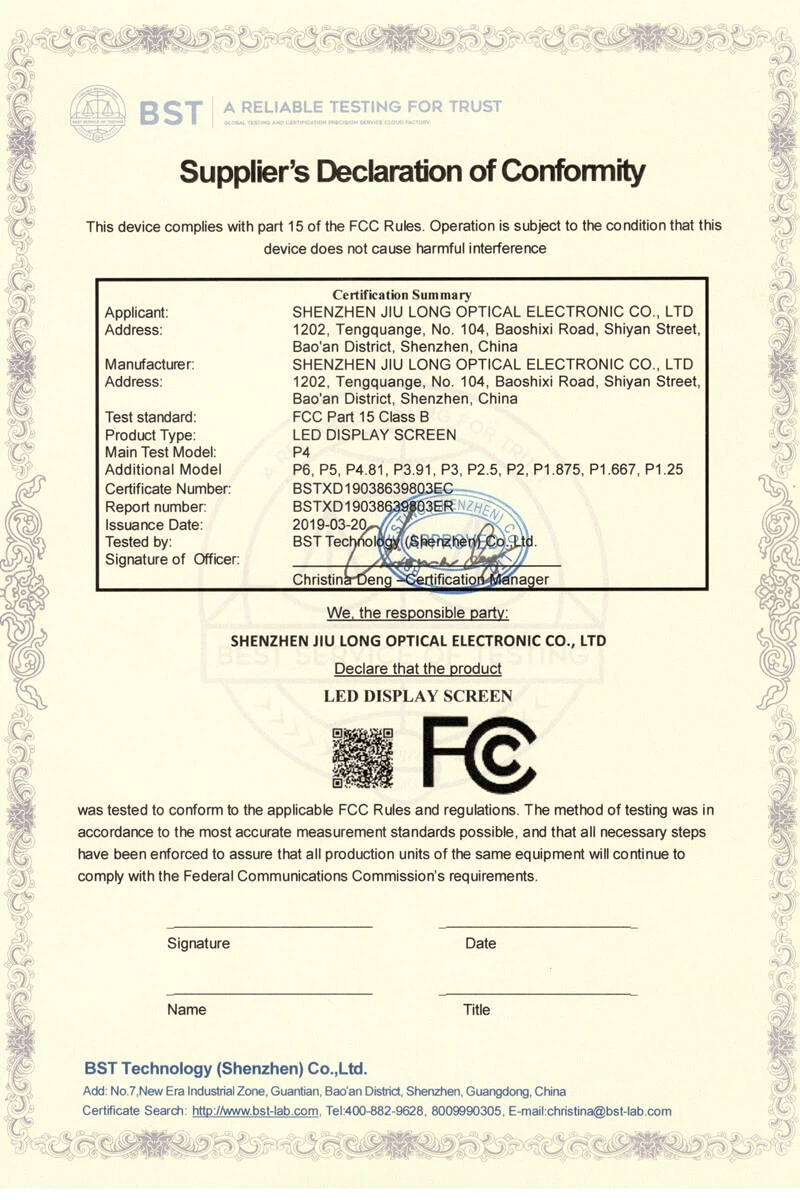
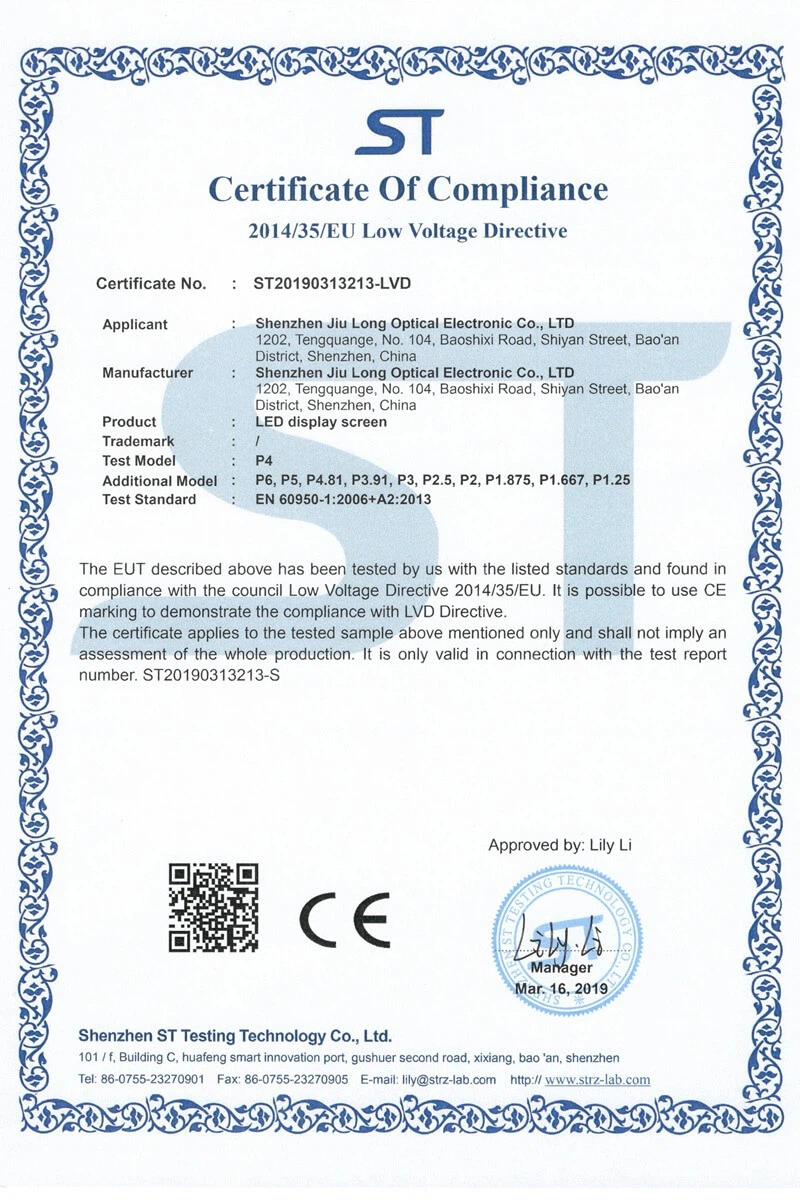


Frequently Asked Questions about Small Pitch LED Screen
Q: What is pitch in LED screens?
Q: What is the smallest pixel pitch LED screen?
Q: What is a 10 mm pixel pitch LED screen?
Q: Is a smaller pixel pitch better?
Q: What is the best pixel pitch for an LED screen?
Q: Is a bigger pixel pitch better?
Q: What is the meaning of p2 in led?
Q: What are p2.5 led panels?
Q: What is the difference between P2 and P3 display?
Q: What are the features of a small pixel LED display?
Q: What are the applications of small pixel pitch led displays?
Q: How to Install a small pixel pitch LED display?
1)Frame pre-installed, our LED display has an ultra-light and slim cabinet, which only requires an elementary frame to hold the whole screen. We will offer back support beams which you will fast on the wall.
2)Install cabinets and connect power&signal cables.
3)Assemble modules to the cabinet. Then you can configure the screen by our manual to make it ready to use.
Q: What is a fine pitch led display?
Traditional LED displays usually have a large pixel pitch, so in the case of viewing close, there may be a significant sense of pixel granularity, affecting the image quality. The pixel spacing of the fine-pitch LED display is relatively small, usually below a few millimeters, and can even reach the sub-millimeter level, so there is almost no pixel granularity when viewed at close range, and it can present a more delicate and realistic image effect.
The fine-pitch LED display is widely used in high-definition video playback, advertising display, indoor stage show and other occasions, especially in commercial displays and indoor places, and its high-quality image performance and visual effects bring more shocking viewing experience to the audience. At the same time, the fine-pitch LED display also has a modular design, easy to install and maintain, and can adapt to the needs of different sizes of sites and various special scenarios.
Q: What is a fine pixel pitch led video wall?
A fine-pixel pitch LED video wall usually consists of a modular LED display, which can be spliced together to form a large-sized high-resolution video wall. In indoor applications, this kind of video wall is often used in advertising display, commercial display, indoor stage show, conference speech, sports events, etc., to provide excellent image quality, attract the audience's attention, and create a shocking visual experience.
Q: Why is your pixel pitch important?
This value also affects what you can expect to pay to create and install your LED wall. Lower pitches often come at a higher price since they require expensive materials and complex manufacturing processes. Higher pitches decrease overall costs but run the risk of being outdated quicker, lower pixel pitches could help "future proof" your LED wall protecting you from rapid technology growth.
As one of the leading small pitch LED screen manufacturers and suppliers in China, we warmly welcome you to buy customized small pitch LED screen from our factory. All OEM&ODM products are with high quality and competitive price. Contact us for quotation.
P0 9 LED Display, curved led screen, Transparent LED Display Wall