


Advertising LED Display
Your Professional Advertising LED Display Manufacturer!
Experienced Company:Shenzhen JIulong Optoelectronics Co., Ltd. was founded in 2012. We are a high-tech enterprise integrating the development, production, sales, and engineering services of LED displays. Our main products include small space LED and LED Screens for rent.
High Quality:Jiulong Optoelectronics LED display screen has reliable quality and realistic images and has won customers at home and abroad. Our products are exported to more than 160 countries and regions in America, Europe, Asia, and Australia, with successful cases all over the world.
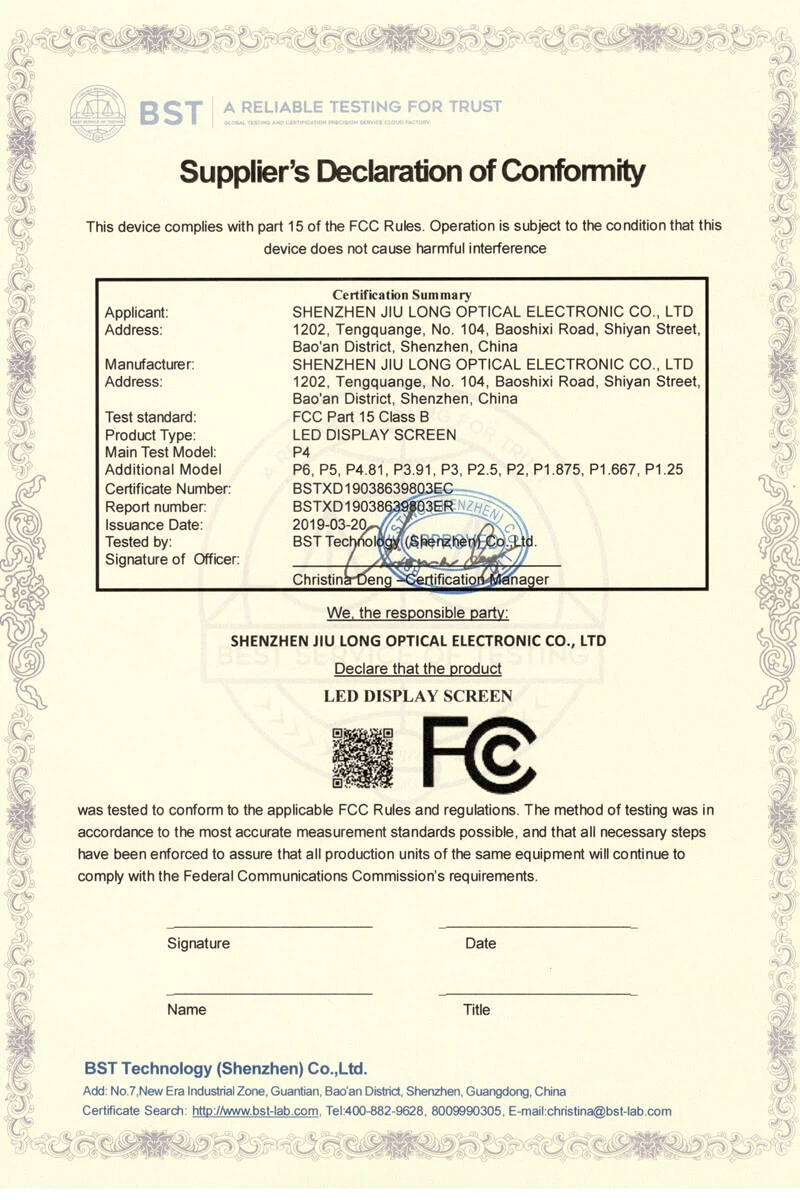
Various Certification:Our products have obtained 3C, CE, CB, IEC, TUV, FCC, RoHS, and other international safety regulations and hundreds of certificates.
Advanced Equipment & Professional Team:We have leading automated production equipment, professional management, R&D, production, and a complete sales and team of service. It provides favorable guarantees of product quality, scale, standardized production, and fast delivery.


What Is An Advertising LED Display?
Advertising LED display, also known as commercial advertising LED display, LED advertising wall, etc., is an efficient, easy-to-operate, high-quality, high-performance visual marketing medium, which is widely used in spreading brands, displaying products, promoting promotions, etc.
Advertising LED display screen is a powerful tool for promoting information in marketing. The digital platform provides excellent display modes such as high-end, high-efficiency, and high-quality, as well as rich resources such as text, pictures, videos, and special effects. It provides users with more new marketing ideas and opportunities.
Why Do You Need An Advertising LED Display?
There is no doubt that display screens have unique advantages in commercial advertising. It is your best assistant in brand promotion and business promotion. Let’s discover its benefits together. Then you will know why you need advertising LED displays.
Eye-catching Picture
High-definition and bright pictures can quickly capture the interest of the audience. How do you get people to stop and take the time to watch an ad? It is the goal of advertising. These bright and vivid screens help you generate more leads.
Multiple Content Displays
You can play various forms of content on the screen: text, pictures, and videos. It means that more creative forms of advertising can be realized. At the same time, you can choose to display specific advertising content at a special time.
High Stability
LED advertising screen has strong stability and a long lifespan. The durable screen performs well even outdoors under variable conditions. You don't need to invest constantly to maintain them.
Smart Operation Methods
Digital billboards have simple control management. Through the network connection, you can easily realize the remote management of the advertising screen. Want to display a specific ad on a billboard in a specific location? It's not difficult.
Types of LED Displays
Text Display LEDs
Just as the name implies, text display LEDs consist of a primary screen which consists of an array of LEDs and they are designed to display only text and alphanumeric information. It is important to note that these types of LEDs displayed are preprogrammed to display certain kinds of text. For example, the Welcome LED board you see in restaurants or the "We're Open"/"We are closed" LED boards you see in various stores are typical examples.
You will notice that the LED is engineered to take the shape of the texts they display; hence, they are fixed, and cannot be changed.
Image Display LED
This type of LED display is often more sophisticated than text display, such that they feature two LED screens and these screens work together to display images. These types of LEDs are capable of displaying text. The images and text displayed in an image display LED are stationary. You will often see these types of LEDs on a typicalsimple billboard.
Video Display
These are the type of LEDs you will find on modern billboard ads such as those in Times Square. And these types of LEDs are designed by featuring numerous high-pixel LEDs that display moving images with a higher resolution.
Digital Display
The only difference between a digital display and a text display LED is that digital display LEDs screens are only designed to show numeric values. They illuminate red or glowing orange light and this is because they are made of a seven-segment digital Nixie tube. This type of Nixie tube uses 7 segments to create all the digits needed to be displayed. You will often see these types of LEDs in banks displaying currency data or in digital clocks.
LED Lattice Image Text Display
This type of LED is capable of displaying text and image data simultaneously. They consist of matrices of LEDs that are arranged in a series of rows and work together to display both text and images. It is capable of displaying text in motion, but the pictures displayed tend to be still. You will often notice that these kinds of LEDs are used to display a variety of text that tend to be in motion. These types of LEDs are used in airports to display gate information and flight details; they are used in concerts to communicate information to attendees, for example, the name of the artist performing; they are used in stadiums to display statistics, and even in some billboards.
The difference between a LED lattice image text display and a text display LED is that an LED lattice image text display can display dynamic text while a text display LED only displays static text.
Applications of Advertising LED Display
Advertising LED display is a modern high-tech product, which has the advantages of high visibility, high brightness and wider display information. Below are some common application scenarios.
Commercial Place
The most commonly used scenarios in the commercial field are shopping malls, supermarkets, brand stores and other places. In these places, LED display screens can display merchants’ advertisements, sales promotion information, and new product promotions to attract consumers’ attention, quickly increase brand influence and sell products.
City Landmarks
Obviously, outdoor LED large screens usually appear in urban core business districts, traffic arteries and densely populated areas. The superior location of these screens means that they have higher marketing value, whether it is brand promotion or business promotion of related companies.
Transportation Hub
In transportation places such as airports, stations, and docks, LED displays are usually used for directions, introductions, and timetable inquiries, which play an important role in guiding people’s travel. In addition, the LED display also plays the role of advertising.
There has never been a better time to make digital advertising an integral part of your company or product’s marketing strategy. Using LED screen advertising as part of your campaign provides the following benefits:
As part of in-store advertising campaigns can be used to boost product appeal and tailored to the retail environment or task at hand for maximum response.
Using LED screen advertising as your Out Of Home (OOH) advertising solution means that your digital content can be published with high-quality outdoor LED screens and relayed to a far broader public audience. Depending on the footfall, traffic speed, and the frequency and duration of your message, you can get your ads in front of a broad cross-section of a local community, potentially generating new interest, widening your audience, and increasing inquiries.
The resolution and quality of this digital advertising are outstanding and will enhance its location with an unchanging high-quality presence. Over time, brands advertised using this media will become recognizable and trustworthy to regular passersby.
Positive returns on investment in digital advertising may lead you to consider reducing the spend on paper-based forms of advertising such as billboards, posters, and printed advertisements. There are also none of the costs of reprinting in case you need to alter a particular campaign.
LED Advertising provides the opportunity to create completely synchronous digital campaigns published and streamed across websites, phones, apps, television and radio, and Digital Out Of Home (DOOH) media. The innovative software and servers involved can be programmed to deliver coordinated and ultra-targeted advertising with a previously unseen level of control and accuracy. All campaigns can be run effectively from a single location.
Real-time updates and edits can be made to advertising, meaning that you can constantly refine the precision of your targeting. Wireless technology and cloud-based computing mean you can remotely control your ads from a variety of advanced software portals to make any desired changes instantly.
Enables some of the most advanced feedback, reporting, and analytics in the industry using sensors and HD video cameras that can accurately record audience response, viewing times, and interaction. Digital content can then be amended according to the demographic data obtained.
Digital advertising can work effectively with social media, QR codes, EPOS, touchscreen technology, and more for targeted ads that can produce an instant return on investment.
In a prominent public space will enjoy fantastic footfall for an attention-grabbing and reactive campaign. The costs of printing and setting up paper-based billboards are eliminated, as are the expenses of new recordings or print runs if advertising needs to be amended. Beyond the capital outlay for equipment and software, the ongoing cost for an LED screen advertising system is low, meaning all profits remain with you.
Once the investment has been made in the appropriate hardware, setting up your digital advertising on the LED screens is straightforward using the supplied CMS and software.
LED Display Technology
With light-emitting diodes, LED display technologies can generate beautiful visual displays of diverse types, each with benefits, disadvantages, and application modes. Some of the most common types of LED display technology include:


Surface Mounted Device (SMD) LED Displays
SMD LED displays use surface-mounted parts to create an efficient viewing experience. Since the displays are mounted directly on a circuit board rather than through a hole, SMD LED displays are more space efficient, unlike conventional LED displays.
This type of LED display technology incorporates three color lamp beads (red, blue, and green) in a single system. You can line up these lamp beads to create images and videos in different patterns. You can also customize SMD displays to meet your needs, as they come in different sizes and colors.
Some of the advantages of SMD LED displays are:
1)Their small size makes them fit for use in areas where space may be an issue.
2)Energy efficiency: They can run on a single power source for a long while.
3)High resolution: They do not rely on backlighting to emit light and create high-quality pictures.
4)Lifetime color compatibility: They retain their original colors for a long while.
Chip-On-Board (COB) LED Displays
Chip-On-Board (COB) mounts LED chips on a printed circuit board (PCB) to create a high-intensity lighting solution. Placing the chips directly onto the PCB creates a higher chip density and a flat, uniform LED surface.
The combination of the red, green, and blue LED chips allows the COB display technology to produce a higher color range and replicate images correctly. The COB technology can accommodate more LEDs than other types of LED displays.
The COB technology has had great breakthroughs in LED due to its awesome benefits, including:
1)Fine pixel pitch: This display can deliver tight pixel pitch and a resolution of up to 4K.
2)Improved thermal management: Its large surface area allows for better heat dissipation and reduces the risk of overheating.
3)Improved reliability: Its surface has dustproof, water-resistant, and anti-corrosion capabilities.
4)Energy efficiency: It produces more light and consumes less energy.
Direct-View LED Displays
Unlike the other LED displays, the direct-view LED display requires no encapsulation layer to display high brightness and contrast. They use individual LED modules to create a seamless display with high resolution.
The direct-view LED display technology contains many tiny LEDs on a panel, which work together to display content like a single screen. Some advantages of this technology include the following:
1)High resolution and image quality: They can produce high-quality images and video content with a pixel pitch as low as 0.9mm.
2)Flexibility: Considering their sizes and shapes, they are flexible and can fit in many forms, making them ideal for creative application.
Transparent LED Displays
This LED display technology has a transparent design that allows you to see through the screen. It’s like a two-way mirror, only that you get to see the visuals on both sides of the screen.
Transparent LED displays allow light to pass through the screen and create a unique visual effect. With this technology, you can easily integrate high-resolution designs into different settings. Based on its innovative quality, transparent LED display has the following benefits:
1)Aesthetics: If you’re looking for stylish, beautiful, and visually appealing content, then transparent LEDs are your best bet.
2)Permeability: They can create a striking visual display and convey a message without obstructing the environment or affecting the ambient lighting.
3)Flexibility: You can customize them to fit any space or shape you desire, which makes them ideal for creative applications.
RGB LED Displays
RGB stands for Red-Green-Blue, and this type of LED is often used to produce aesthetic and colorful illuminations. If you are into gaming or decorations, you have probably seen an RGB LED.
The way this LED works is simple, each RGB LED has a red, green, and blue component attached to the LED. So, depending on the color to be displayed, the current flowing through either of the red, green, or blue components is varied, as a result, each color component is either made to be dimmer or brighter. For example, to produce a purple color, the current flowing through the red and blue components is heightened, while the current flowing through the green component is lessened, as a result, the purple color is achieved.
So, the ability to control the illuminance of either of the three color components of the RGB LED is the reason why this type of LED can produce various and almost all colors.
Mini-LED
The idea of a mini-LED is built off that of a QLED. Essentially, it features the same technology as a QLED, with the only difference being that the LEDs on the backlight are much smaller and numerous; hence the name. Due to the numerous LEDs, it can be further sectioned into more zones providing more control of the black levels and more contrast compared to a QLED.
Micro-LED
Micro-LED technology is a variation and an upgrade of the OLED. Unlike OLED which uses organic materials to produce its light, micro-LEDs use inorganic materials such as Gallium Nitride to produce its light. Due to the use of inorganic materials, this type of display tends to produce brighter images with less.
How to Set Up a Digital Billboard?
A digital billboard displays the content you have prepared on an electronic display rather than on a vinyl board. A digital billboard works using three chief components― the Hardware, the Software, and the Content.
Hardware
Your hardware consists of two essential components:
1)The digital display or screen:
The billboard screens can vary in size from 6 feet tall and 12 ft wide to 14 feet tall and 48 feet wide. As outdoor displays, digital billboards must be energy-efficient and immune to external stress factors such as harsh weather, extreme heat and vandalism. Since these outdoor electronic displays are typically placed higher up from the ground, a particular emphasis on the screen resolution is required. The average digital billboard is visible from a distance of 500 to 2,500 feet.
2)The digital signage player
This is a small box connected to your display (looks like a set-top box). Just like the set-top box enables you to watch your favorite shows on your TV, a signage player drives functionalities like downloading the content uploaded in the form of images or videos and rendering the visual quality of the media on digital billboards.
Software
Next comes the brain of your digital billboard― the digital billboard software. This software is the content management platform that allows managing your billboard screens and publishing media files to the network.
Nowadays, most billboard software platforms are hosted online, giving admins immense flexibility to access their dashboards and remotely change the content from any geographic location.
Content
Finally, it is your content that rules! A digital billboard screen can show several kinds of content, such as images, social media posts, scrolling text, animations and more. Modern digital billboard software lets users publish live content like real-time weather updates, traffic updates, and news flash.
4 Tips for Choosing the Right Advertising LED Display
Finding the right advertising display among all the different options is not just as easy as walking in the park. You should go for a product that meets all your business requirements. Make sure that your outdoor Advertising LED Display or any other advertising screen is compatible with the digital signage software that you intend to use. Below are some of the tips you should employ to find the right advertising screen for your Digital Signage project.

Start With a Leading Question
Ask yourself a question, what goal do you want to accomplish with the installation of your advertising screen? Do you want to provide information or entertainment through an outdoor wall mount LED Display? Take your time and plan the entire decision-making process of your advertising screen installation.
Do Not Ignore the Environmental Factors of Your Advertising Screen
The LED screen can be installed outdoors or indoor depending on your needs. Outdoor Advertising LED Display with excellent brightness and the ability to adapt to various conditions is needed to show great pictures in ambient light. Get an outdoor case to cover your device to protect it from harsh weather conditions.
Pick the Right Size for Your Digital Signage TV
It might sound simple but it’s not easy at all to pick the optimal screen size. You need to decide how far into the distance you want your screen to be visible. It has a direct influence on the perceived quality of the advertising screen or we can say, the content displayed on the screen.
If you want to take the advertisement to the next level, you can even look into the deployment of a video wall. Picking up the bigger video walls of about 45” inches is somewhat best for large engagements and thus is used at trade shows, in store windows, conferences, and in classrooms.
Always Choose the Right Resolution
LED screens with the resolution of 1080p are standard for better image quality and Full-HD support. Using 2160p and 3840×2160 pixels for Ultra-HD or 4096×2160 pixels for 4k resolution is a great resolution for video playing. You can even go for the original resolution to achieve optimal playback quality.
Our Certification





Frequently Asked Questions about Advertising LED Display
Q: What Is LED?
Q: How does the LED display system work?
Q: What is LED display advertising?
Q: How do electronic advertising boards work?
Q: What is the difference between an LED display and an LCD monitor?
Q: What is a full HD screen?
A full HD screen has 1080p image resolution and 2 million total pixels. Most modern films and games are created to appear best on these screens. Some TV channels still broadcast in standard definition, but for computer games or a cinema-style experience, full HD is essential. A full HD screen also offers significantly higher picture quality than the next best option at 720p image resolution.
Q: Which display is better LED or HD?
Q: How much power does an LED display use?
Q: What is the purpose of LED display?
Q: Are LED screens sustainable?
Q: Is it possible to purchase a custom-size giant screen?
Q: Is it possible to visualize a Video on the LED display?
Q: What is the difference bertween SMD and PTH LEDs?
The SMD TOP LED is therefore mounted on the external part of the board (without the anode and cathode passing through holes), as described in the image below (proportions are real): LEDs utilizing the SMD technology are different from the PHT LEDs for another important characteristic: thanks to the miniaturization indeed it is possible to put 3 LEDs of different colors within the same case (as in the picture on the top-right), resulting in a three colors LED.
The possibility to visualize three colors at the same time (Red, Green and Blue) on a single LED allow to create digital billboards with an even smaller pitch (the distance between pixels) therefore resulting in a higher resolution and quality image.
Q: What are the color levels?
Q: What is a pixel?
Q: What is the viewing angle of an LED wall?
For example, an LED screen with 5000 NIT frontal luminosity (NIT = millicandels/sq) has a visibility angle equal to the angle by which the brightness is reduced to 2500 NIT. This visibility angle can vary depending on the LED and the technical features of the display.
Q: Can variable message led signs read GIF images?
Q: Can you see the images on both sides of an LED screen?
Q: What is the outdoor LED screen?
The outdoor LED display refers to the display used outdoors. The brightness of outdoor displays is high, which is dozens of times higher than that of indoor LED displays. In addition, the outdoor LED display also has good functions for waterproofing and heat dissipation.
Q: Why is LED more expensive than LCD?
As one of the leading advertising LED display manufacturers and suppliers in China, we warmly welcome you to buy customized advertising LED display from our factory. All OEM&ODM products are with high quality and competitive price. Contact us for quotation.
led transparent, digital sign board for shop, outdoor lcd screen