


LED Screen
Your Professional LED Screen Manufacturer!
Experienced Company:Shenzhen JIulong Optoelectronics Co., Ltd. was founded in 2012. We are a high-tech enterprise integrating the development, production, sales, and engineering services of LED displays. Our main products include small space LED and LED Screens for rent.
High Quality:Jiulong Optoelectronics LED display screen has reliable quality and realistic images and has won customers at home and abroad. Our products are exported to more than 160 countries and regions in America, Europe, Asia, and Australia, with successful cases all over the world.
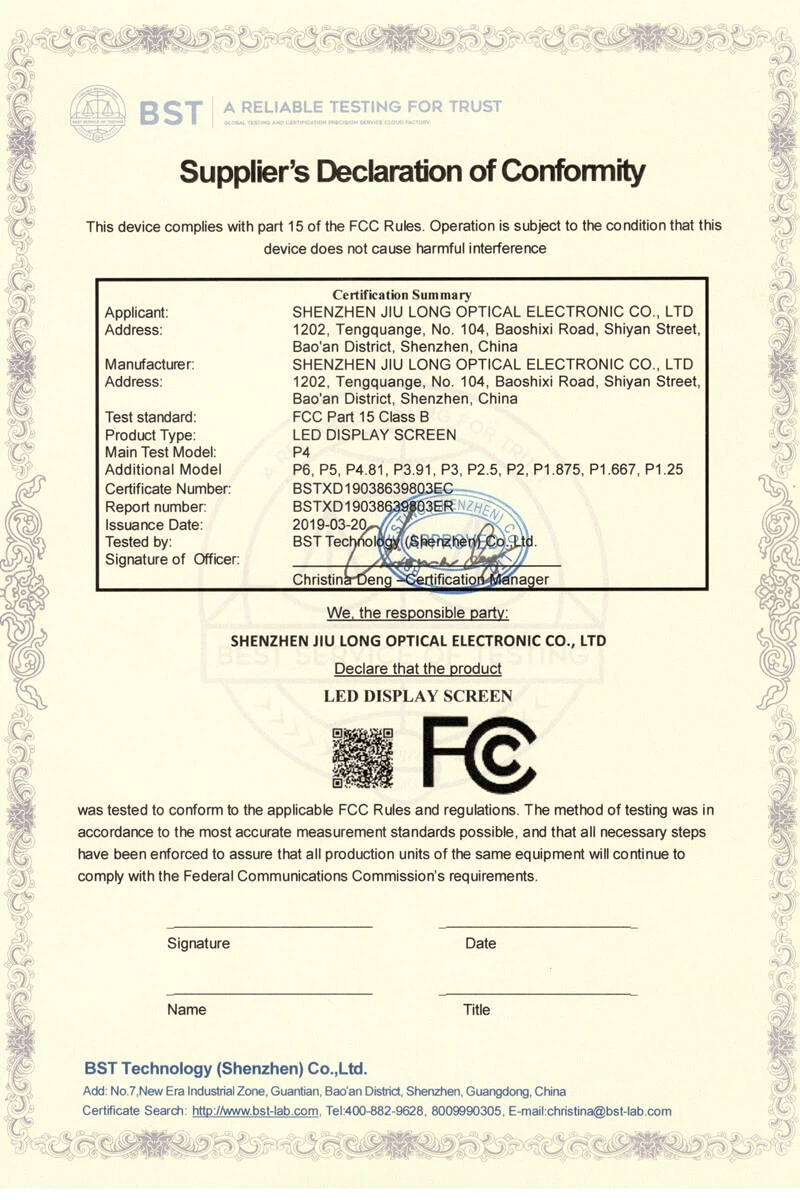
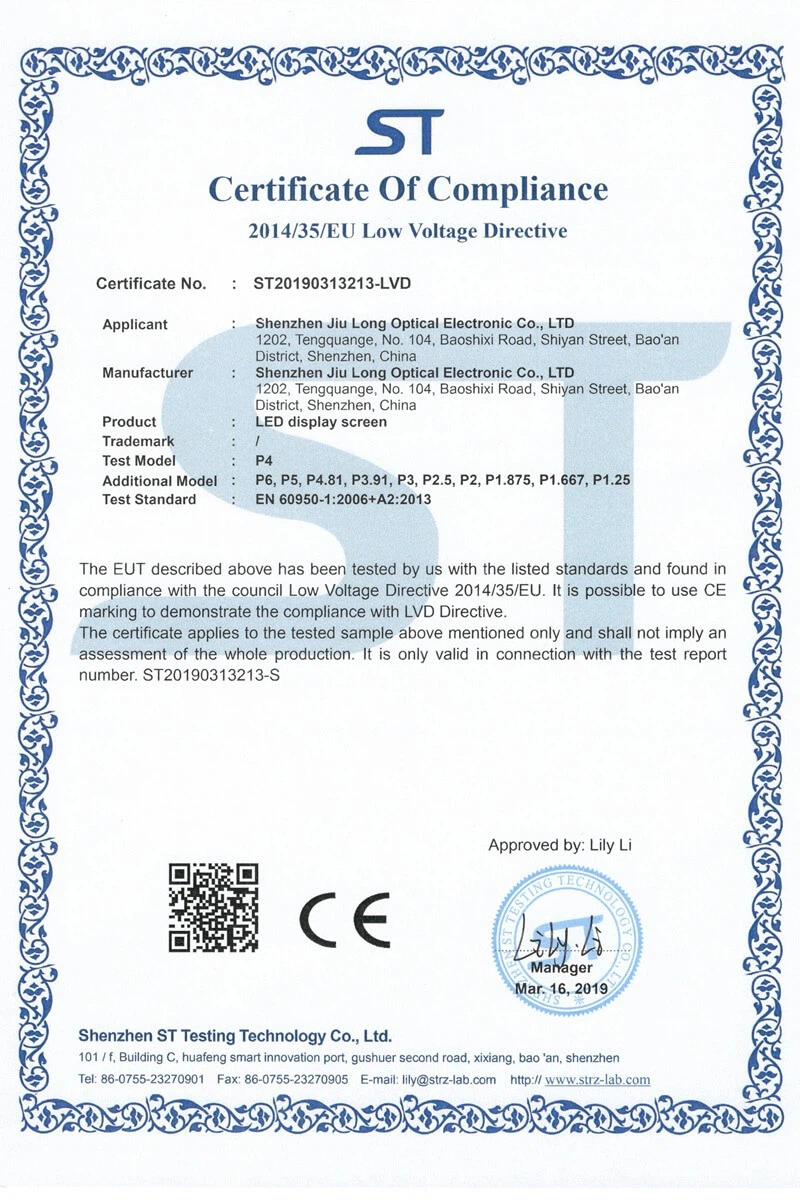
Various Certification:Our products have obtained 3C, CE, CB, IEC, TUV, FCC, RoHS, and other international safety regulations and hundreds of certificates.
Advanced Equipment & Professional Team:We have leading automated production equipment, professional management, R&D, production, and a complete sales and team of service. It provides favorable guarantees of product quality, scale, standardized production, and fast delivery.


What Is An LED Screen?
The LED screen is the most recent type of digital monitor that can display images of Full HD quality. These screens now provide incredibly sharp pictures, making them ideal for outdoor advertising.
LED is an abbreviation for Light Emitting Diode. When electricity is transmitted through it, a semiconductor light source displays a visual. An LED screen is made up of different types of red, green, and blue diodes that work together to make one full pixel. This form of pixel is extremely crisp and visible from a long distance.
This question is most often asked in comparison to projectors and projector screens. The projected image is a reflection, not actually a light source, so the maximum brightness you can get off of a reflection is never enough in sunlight versus an LED screen. LED Screens are light emitters, as opposed to standard projection screens which are light-reflectors. This means that the screen IS the light source, so you get brighter images and more vibrant colors. LEDs actually produce colors in a range greater than most video cameras are capable of capturing! Unlike projection screens, LED Screens are useable in bright environments such as convention centers, stages with full scenic lighting, and even the sunny outdoors.
Another question we get often is in comparison to flat panel television walls. In this scenario, several TVs are butted together to make the wall. The first problem here, and probably most glaring, is the seams between the walls. Viewed side by side, the LED screen is one large seamless screen, where the TV panel matrix’s seams are constantly, jarringly there. It’s very hard for the brain to forget that these seams are right in the middle of the image and they are a constant distraction. Another problem with them in comparison to LED screens is their picture. The TV panels just can not produce the same amount of brightness and crispness that an LED screen can, and that’s what attracts the eyes. With our ultra-high resolution panels, we can achieve the same HD quality and much higher brightness and contrast than any flat panel TV wall matrix.
Another huge reason to consider LED is that outdoor LED screens are built for the weather, and can remain in service during a rainstorm. This is a huge plus for event organizers, especially in the summer when unexpected weather could develop at any time.
Types of LED Screens
As a popular medium for information display and advertising, LED display screens have various applications. With the progress of LED technology and the update of LED products, LED display types are also more abundant.
According to different distinguishing standards, there are various types of LED displays.


Rental LED display/Fixed LED Display
(1) Rental LED display
A rental LED screen is a display that can be repeatedly disassembled and installed. The LED screen cabinet is thin and light, saving space, and can be put together in any direction and size to present various visual effects needed.
High-quality Rental LED display selects SMD surface mount three-in-one packaging technology, which can achieve 160° ultra-wide angle. And it can meet the viewing needs of different directions.
They are suitable for various indoor and outdoor stages and events. Such as concerts, weddings, music festivals, cultural evenings, etc.
(2) Fixed LED Display
A fixed installation screen cannot be easily moved once installed. The box adopts a simple or standard waterproof cabinet, which mainly plays the role of fixing and waterproofing. The structure is relatively heavy.
For example, the column-type LED billboards next to the highway, and the advertising LED screens on the exterior walls of buildings. According to the installation environment on site, fixed LED displays have various installations, such as wall-mounted, column-mounted, etc.
Fixed LED displays are used for TV video programs, VCDs or DVDs, and live feeds, advertising, etc.
Fine Pixel LED Display
Fine pixel LED display is a kind of display with a small lamp bead pitch and high pixel density. High-pixel density displays are generally available on the market.
LED displays below P2.5 are called fine-pixel LED displays. With a choice of high-performance driver ICs, low gray, and high refresh rates, it can be seamlessly stitched together horizontally and vertically.
Small-pitch LED screen is widely used in indoor applications. Such as airports, schools, transportation, gaming, conference rooms, etc.
Indoor/Outdoor LED Screen
(1) Indoor LED Display
Indoor LED displays are mainly used for indoor use and are generally not waterproof, with outstanding display effects and a variety of forms that attract the eye.
Indoor LED displays are used in hotel lobbies, superstores, KTV, commercial centers, hospitals, etc.
(2) Outdoor LED Display
The outdoor LED display is a device for outdoor display advertising media. Multi-level grey-scale correction technology improves color softness and automatically adjusts brightness with natural transitions.
The screen is available in a variety of shapes and can be coordinated with various architectural environments.
Outdoor LED displays can set the festive mood. Promote the company’s product advertising, information transmission, etc., commonly used in construction, advertising industry, companies, parks, etc.
Single/Double Color LED Display & Full-color LED Display
(1) Single/Double Color LED Display
Single Color LED displays are commonly available in red, blue, white, green and purple, etc. The content of the display is usually relatively simple text or patterns.
LED dual-color displays are colorful and common combinations are yellow-green or green-red or red-yellow-blue, with bright eye-catching colors and a more eye-catching display.
Single/double color LED display mainly for information dissemination and transmission in passenger stations, traffic junctions, etc.
(2) Full-color LED Display
The full-color LED display is a display that can show a variety of colors in a comprehensive range of colors, hence the name full-color display.
Each luminous point contains various base colors of grey, which can form 1677216 kinds of colors, the picture is gorgeous and natural.
It is also designed with a professional mask, which is waterproof and dustproof and has a long service life.
They are suitable for office buildings, high-speed railway stations, commercial advertising, the release of information, exhibition centers, etc.
Common Applications of LED Display Screens
LED screen is a great invention of the modern world. The display screens have become a unique source of visual pleasure. They have added a whole new aspect to our life. Just imagine, if there weren’t LED display screens, you wouldn’t be able to view what is happening in the world.
The display screens are not only crucial for entertainment purposes. They are also essential elements in health, daily life, the military, and construction. We can only list some of the applications of LED screens. Here are some common applications of LED screens:
Stage Events
LED screens provide a unique atmosphere to stage events. They can turn the event into a fun and thrilling spectacle. We use display screens in many different applications, including stage events. They can display content and provide a better experience for the audience.
These display screens have become quite popular now. It is because of the advancements in LED technology. This progress has made them more efficient and cost-effective. And the use of screens for stage events has become a regular thing. They have become a source of visual pleasure.
Shops and Malls
They are a great way to display information in a shop. They are more efficient and effective than traditional displays. And we can use them for this purpose in shops and malls also.
We have been using LED video screens in retail stores for years now. We have done so through digital signage, video walls, and posters.
Moreover, we can use LED screens in directories and entertainment stores. These screens can create a mesmerizing effect on people. They can attract pedestrians to the shopping malls. They will inspire and make them browse your products. Moreover, you can advertise the objects on these screens.
I am confident that display screens have the power to captivate the mind. As a result, pedestrians are more likely to come to your shop or mall. It is an investment worth investing in for your business.
Meeting Rooms
It is hard to deny that almost all modern meeting rooms and offices have LED screens. It is because I think they are an excellent tool for communication. First, you can use them to let the audience know what the speaker is saying. Then, you can start a video call without wires or any equipment.
People use these screens to display information and data in meetings. You can show presentations, videos, and other content.
There are many uses for a display screen in meeting rooms and offices. One benefit is sharing presentations with those who are remote. It requires some transmission infrastructure such as WIFI. You can use it to enhance a conference call by having remote participants that connect them all.
Cinemas
In general, cinemas have been replacing traditional film projection with LED screens. The primary purpose of screens in cinema is to display movies or films. But with the world progressing, there are improvements in the display and cinema.
You may have heard about the 2D or 3D visuals or stuff like that. There are more modern cinemas nowadays. This advancement is due to innovations in LED screens. It has enabled the cinemas to give a visual experience they lacked previously. I can say LED screens will go into all cinemas shortly.
Airports and Stations
We have applied LED screens in airports and stations for a long time. But, they have rapidly increased over the past few years. It is because they are more efficient than traditional methods. They are also more environmentally friendly than conventional methods of providing information.
We can use them to provide important information in airports and stations. This information can be about the flight or train schedule, weather, etc.
These display screens are a great way of communicating with all travelers. For example, keeping discipline with so many people at airports is challenging. With LED screens, everyone can see which flight is taking off and which is landing.
Restaurants and Hotels
LED screens are becoming more and more popular in hotels and restaurants. You can use them to provide a better experience for the guests. They can provide an interactive experience to the guests. They can offer an aesthetic look and entertain the people.
You can use them to show information about the hotel or restaurant. This information can include their location, hours of operation, or special offers. Display screens can also hint about the food served at a restaurant or hotel. It helps customers decide what they want to eat or drink before they even get there. And you can raise people’s appetite by showing the food on the screen.
Advantages of Advertising LED Screens in Your Business
Any type of business or company needs to advertise correctly to promote its different products or services, whether in a single column, on a facade or in a shop window. LED advertising screens are very popular communication devices today, since they provide great benefits to users by offering a perfect display of the ads. The use of LED screens to display advertisements allows companies to choose innovative and technological means to display to the public, thus reducing the cost of installing and removing posters on traditional billboards.
More Creative and Impactful Messages
One of the main advantages that this type of advertising LED screens or electronic signs allows is that videos, images and even text can be easily combined. The facts have shown that because pedestrians have greater excitement in the human brain, pay more attention to moving images or images that change once in a while. In addition, today's LED screens have no time limit or format, so it is possible to create new advertising messages that will be internalized by the viewer who passes by.
Great Visual Impact Among Users
Today, online advertising is very common, but because personal computers have various utilities, they are easy to block. In this regard, the LED display can be a good solution, Because of its large size and striking color, it is difficult for users to ignore the displayed message. A good option is to place this type of LED billboard near the traffic lights to ensure that a large number of public see the advertisement when you drive through these places.
They Have High Durability and Excellent Quality
LED screens used in advertising have a great durability, as they can withstand great resistance to bad weather and bad weather, thus extending the useful life. Furthermore, due to its higher brightness and resolution, the quality of these displays far exceeds that of traditional displays. This type of electronic signs and LED panels are great quality, even if the sun is shining directly on the screen, as it can display messages perfectly throughout the day.
Economically Profitable and Return On Investment
Not using traditional posters can save a lot of money and can be better environmentally friendly, as you can avoid indiscriminate use of paper. It is also important to note that the LED display content can be programmed remotely and instantly, which is only necessary for devices with internet access.
Also, compared to traditional illuminated billboards, the power consumption of LED displays is much lower.
Important LED Technical Terms to Know
While we are talking about LED technology, here are some technical terms that you should be familiar with:
Pixel pitch is the distance between the centers of two adjacent individual pixels on the LED panel. A short pitch results in high resolution and better picture quality. The minimum viewing distance from the LED display is also determined by the pixel pitch. If you view the LED display from a closer distance, you can spot the individual LEDs.
Pixel density is the number of pixels present on a given area of the screen. Generally, it is measured in pixels per inch (ppi). The quality of an image displayed on a screen improves significantly as the pixel density increases. Note that pixel density in smaller devices like the screen on your smartphone is considerably higher than in large devices like a television or LED video wall. For instance, an iPhone may have a pixel density of over 458 ppi, while a 50-inch 4K TV might have only 80 ppi.
The angle from the center of the LED display at which picture brightness becomes less than 50% of the nominal. In simple terms, this angle tells us the maximum position at which the viewer can still clearly see the display image. For instance, if the angle is 40 degrees, the viewer can still see the image correctly 20 degrees left and 20 degrees right of the screen.
LED scan rate is a ratio that represents how much of the LED array lights up at a given point. For instance, a scan rate of 1:16 means 1/16th of the LEDs are lit at any given instant. After, the display moves to the next 1/16th. Not all the LEDs are activated. Doing so would result in high power consumption and require more processing power. Instead, a fraction of the LED array is lit at a given instant. Then the principle of Persistence of Vision is used, which means the image our eyes see lasts for a fraction of time.
LED Screen Display Lifespan
Determining the lifespan of LED screens is a bit tricky since you have to put various factors into play. Despite this, proper maintenance can give your display more than 10 years. Many variables may affect the lifespan of your display screen such as:
Extremely High Temperature
Installing an LED screen where the ambient temperature is extremely high without a proper cooling mechanism will affect the lifespan. Even though modern displays have effective cooling systems, at times you may need additional cooling systems.
Remember, extremely high temperature causes diodes degradation. Therefore, the lifespan will reduce significantly.
Design and Configuration
The overall architecture will determine whether the LED panel will serve you for long or not. Take for example, inefficient cooling causes faster diodes degradation.
Apart from these, content with numerous color variations and brightness may affect the average service lifespan.
But even these LED screens still guarantee a long lifespan.
Using No-recommended Power Supply
Don’t improvise any power systems. The power rating and frequency must match the manufacturer’s specifications.
Failure of Other Components
The display has other components such as cooling systems alongside other accessories. Whenever such parts fail, remember the lifespan of your LED display will reduce significantly.
Temperature:LED screens work best at an ambient temperature of <30℃.
Humidity:LED screens work best at a humidity level of <60%. Otherwise, the components start to corrode, and short circuits become more likely.
Pests:Ensure that the LED screen will not suffer from mouse or rat bites. Use rodenticide or pest control for that.
Power:Ensure good grounding of the power source and protect it from electrical surges.
Dust:Dust will settle on the internal control device’s surface, lowering its heat conductivity and insulating capabilities. In humid conditions, dust will absorb the moisture in the air and result in a short circuit and a potential fire hazard. Dust can also harbor mold spores that will compromise the performance of your LED screen. Therefore, cleaning LED displays plays a crucial role in maintenance.
Sequence:LED screens have a certain sequence of operating that ensures a longer lifetime. When you are either turning the screen on or off, the control computer should go first, and then the screen itself.
Luminance:Avoid leaving the screen fully illuminated for an extended period of time to prevent damaging the LED bulbs and overheating the power line, which would shorten the screen’s lifespan.
Usage:It is advised to give large LED display screens more than two hours of rest each day. In general, leave the screen on for no less than 2 hours at least once every month. Don’t leave the LED display off for too long. If the screen hasn’t been used for more than three days in a humid environment, turn it on by preheating it first for 4 to 12 hours.
Circuits:Check your LED display panel frequently to determine if it functions normally and to rule out any circuit damage. Replace it as soon as possible if it breaks. To preserve ventilation, heat dissipation, and reliable computer performance, place the primary control computer and other relevant equipment in air-conditioned and dust-free rooms.
Fastening:LED screens use a lot of energy. Terminals of the power source and signal terminals will become loose as a result of the change in the heat after operating for a while and being repeatedly turned on and off. As a result, constant tightening of the LED display connector is required. When adjusting fasteners, use balanced and adequate strength while preserving the inherent effectiveness.
Our Certification




Frequently Asked Questions about LED Screen
Q: What is an LED Display?
Large LED displays use a large number of these diodes to light up the screen. These diodes are low power consumption devices that provide high brightness. As a result, an LED screen has several benefits over other display alternatives.
The fluorescent bulbs used earlier could only give black and white tones. However, an LED screen can display the entire colour spectrum by combining red, blue, and green colours (RGB).
The advantages of an LED screen are so many that you can find LED screens everywhere. From TVs to computer monitors to high-resolution billboards in shopping centres and LED video wall applications.
Q: What is an SMD LED screen?
Q: How does an led display work?
To create a bright colour image, the principles of additive colour mixing are used, whereby new colours are created by mixing light in different colours. An LED display consists of red, green and blue LEDs mounted in a fixed pattern. These three colours combine to form a pixel. By adjusting the intensity of the diodes, billions of colours can be formed. When you look at the LED screen from a certain distance, the array of coloured pixels are seen as an image.
Q: What is RGB?
Q: What is SMD?
In LED display technology, the SMD concept is used a little differently. An SMD display is an LED display where the red, green and blue diodes are potted in a small plastic encapsulation which is surface mounted on the printed circuit boards of the display. When the diodes are encapsulated in this way, they take up a lot less space, making it possible to produce displays with less spacing between the diodes and higher resolution.
Q: How much power does an led display use?
There are many different types of LEDs and displays. The power consumption of an indoor display, for example, will be different from an outdoor digital sign, which has to be seen in direct sunlight. The brightness of the display is also a major factor. The images must be clear, but the light from the display must not dazzle. An outdoor LED display needs to be far brighter in daylight than when darkness falls.
What is displayed also has an impact. LED displays display images by turning on and adjusting the brightness of coloured diodes. An entirely white image with black text will therefore require many more illuminated diodes – and far more power – than white text on a black background.
Q: How long does an led display last?
Over the course of the life of an LED display, the light output from the diodes will diminish. By how much depends on the type and generation of the diodes. Many LED displays never use their full light intensity, so reduction will rarely be a problem.
Q: What is pixel pitch and display resolution?
If an LED display has a pixel pitch of 1 cm, there may be 100 x 100 pixels per square meter of display. The resolution of a display is given as a pair of numbers that indicate the width and height in pixels. If you have a 6 x 8-meter screen with 1 cm in pixel pitch, it has a resolution of 600 x 800 pixels.
There are LED screens with a pixel pitch of anywhere from several centimeters to a single millimeter.
Q: How do LED screens work?
Q: What does LED stand for?
Q: When were LED displays invented?
Q: Are LED displays good?
Q: Is LED better than LCD?
Q: Is an LED screen worth it?
Q: What is the difference between LED and LCD monitors?
Q: What is LCD vs LED vs OLED?
Q: What is the purpose of the LED screen display?
Q: How do you take care of led screens?
If possible, you should run your LED display screens more frequently. It is recommended that you turn on LED displays at least three times every week for a minimum of two hours each time. Only turn off the power to the control device and keep the LED screen in standby mode if you won’t be using it for an extended period of time. It will significantly lower the power consumption of the device by doing so.
As one of the leading LED screen manufacturers and suppliers in China, we warmly welcome you to buy customized LED screen from our factory. All OEM&ODM products are with high quality and competitive price. Contact us for quotation.
Outdoor Flexible Led Display Screen, indoor led wall screen, Pantalla Led Display Screen