


Indoor LED Display
Your Professional Indoor LED Display Manufacturer!
Experienced Company:Shenzhen JIulong Optoelectronics Co., Ltd. was founded in 2012. We are a high-tech enterprise integrating the development, production, sales, and engineering services of LED displays. Our main products include small space LED and LED Screens for rent.
High Quality:Jiulong Optoelectronics LED display screen has reliable quality and realistic images and has won customers at home and abroad. Our products are exported to more than 160 countries and regions in America, Europe, Asia, and Australia, with successful cases all over the world.
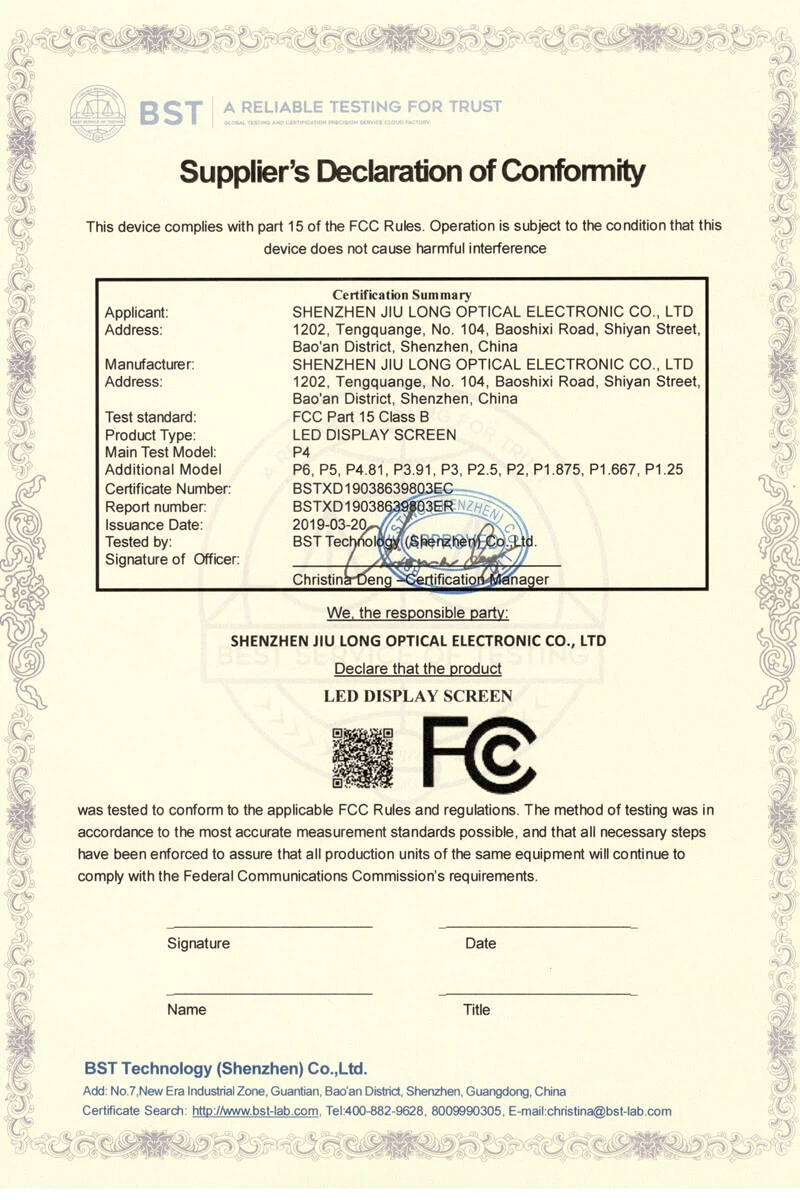
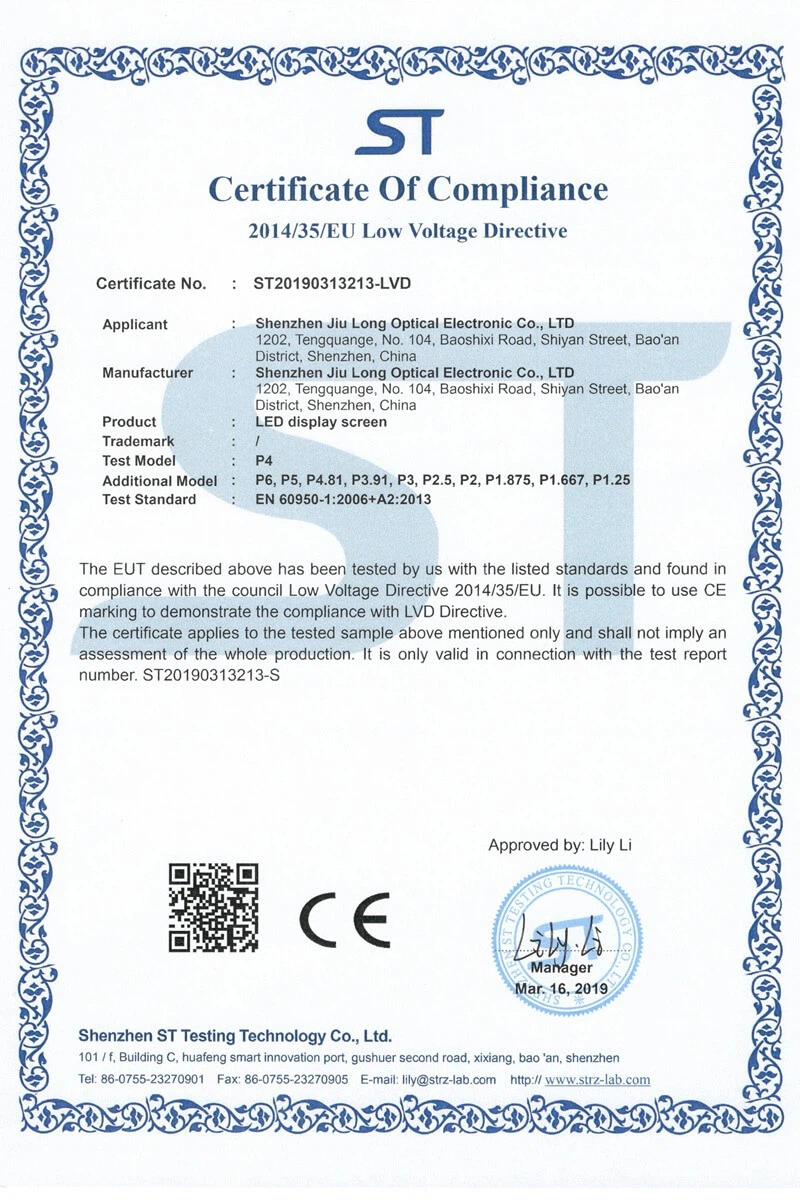
Various Certification:Our products have obtained 3C, CE, CB, IEC, TUV, FCC, RoHS, and other international safety regulations and hundreds of certificates.
Advanced Equipment & Professional Team:We have leading automated production equipment, professional management, R&D, production, and a complete sales and team of service. It provides favorable guarantees of product quality, scale, standardized production, and fast delivery.


What Is A Indoor LED Display?
An indoor LED display screen is a type of electronic display that uses light-emitting diodes (LEDs) to produce high-quality images and videos. They are designed for use in indoor environments, such as shopping centers, trade shows, conference halls, and other similar spaces. Indoor LED display screens typically come in a variety of sizes and resolutions, making them a versatile and flexible choice for a wide range of indoor advertising and information display applications.LED display screens are known for their brightness, color accuracy, and wide viewing angles, making them ideal for use in well-lit environments. They are also energy-efficient and have a long lifespan, which makes them a cost-effective solution for businesses looking to invest in indoor advertising and marketing.In recent years, indoor LED display screens have become increasingly popular due to advancements in technology, which have improved the quality and affordability of these displays. They are now widely used by businesses and organizations looking to reach a large audience in indoor environments and make a lasting impact with their advertising and marketing messages.
Features of Indoor LED Display
High Definition
The pixel pitch of the indoor LED screen is smaller, making the image presentation more accurate and sensitive, ensuring high-quality picture performance.
Wide Viewing Angle
Supports a wide viewing angle display of 170° horizontally and 160° vertically, which can better meet the needs of spacious indoor spaces and provide better visual effects and a broader field of view.
Multi-Screen Display
Supports block management mode, allowing different areas to display different content independently, realizing simultaneous playback on multiple screens, and providing more flexible and diverse display methods.
Full Color, High Brightness
The indoor LED display has a high brightness of up to 2000MD/M2, far exceeding other large-screen displays. More importantly, it can intelligently adjust the brightness according to the intensity of indoor light, ensuring the visual health of the audience and providing a more comfortable viewing experience.
Types of LED Displays
LED screen displays can generally be divided into two groups: Indoor LED Display and Outdoor LED Display.
Indoor LED Display
An electronic display panel that uses light-emitting diodes (LEDs) to produce images and content is referred to as an indoor LED display. It is intended for use in indoor settings like retail stores, malls, theatres, and conference rooms. The LED display is made up of tiny LED modules that are arranged into a pixel matrix to produce vivid, high-resolution images. With their superior brightness, contrast, and colour reproduction, these displays guarantee clear, vibrant images. They are frequently utilised for interior visual enhancement, advertising, information display, and entertainment.
Outdoor LED Display
Large electronic display screens made specifically for outdoor use are called outdoor LED displays. It produces vivid and bright images by using light-emitting diodes (LEDs). These displays are strong, resilient, and waterproof against inclement weather, direct sunshine, and fluctuating temperatures. Outdoor LED displays are frequently utilised for events, information for the public, entertainment, and outdoor advertising. They are a useful medium for drawing attention and spreading messages in outdoor environments because of their great brightness, broad viewing angles, and capacity to display high-resolution content.
Where to Use Indoor LED Display?
Indoor LED display can be used in the sales gallery. Sales gallery is usually where a company promotes and sells their products. So, this is when an indoor LED display comes in, to exhibit the product information, to show the introductory video and it also acts as the backdrop of the sales event.
Some may wonder, why should it be an indoor LED screen? The reason is none other than the features and the benefits it offers. Applying an indoor LED display at the sales gallery will increase the engagement from potential buyers. In a sales gallery, a video will be played to show the overall product and with the indoor LED screen, it offers high brightness and rich colors. Indeed, the sales gallery is one of the best applications for indoor LED screen. The best pixel pitch size for sales gallery is P2.5
Here is another best application of an indoor LED display. As the technology evolves, hotels should take an initiative approach to be more innovative. Visitors visit hotel ballrooms for several reasons, for instance, they go to a hotel ballroom for an event, let it be a business event, wedding ceremony or a family event. When they are choosing a hotel ballroom for their events, many choices will cross their minds. So, it is safe to say that a hotel ballroom that can provide the best solution will most likely be chosen. An LED display screen in a hotel ballroom will be a bonus point. The suitable pixel pitch sizes to choose for hotel ballroom are P2.5, P.30, P4.0, P5.0.
Indoor LED displays can also be applied in broadcast and TV stations. The application here is to use as the background. Background of any TV show is very crucial as viewers’ attention will be focused there. Indoor LED display allows the background to be changed in real time for decorative purposes or for information sharing. The live show will not seem boring with the LED Indoor Display applied. If there is no information to be displayed, interesting and eye-catching decorations can be put up on the screen. Viewers will stay engaged all along.
Indoor LED screen is used for retail advertising and indoor advertising. Indoor LED Screen can be used as a way to reduce the printing works. Retail industry uses many printings for the promotions, and it is frequent. With indoor LED screen, no printings have to be done. Everything will be done digitally. Promotions can always be updated within a few clicks, no printing, no hassle. Everything is at the fingertips. Not just that, quality images displayed on the Indoor LED Screen is guaranteed. P2.5, P3.0 and P4.0 will be among the suitable pixel pitch sizes for retail advertising and indoor advertising.
Indoor LED display is one of the best tools to be used in advertising as it shows engaging content, grabs the attention and will reach the audience. An indoor LED screen is an eyecatch to anyone who sees it.
What Are the Advantages of LED Display?


An LED Display uses Highly Reliable Technology
LED displays use technology that’s extremely reliable. There are many people that consider LEDs to be one of the most outstanding inventions of the last century. You’ll find LED display technology used for digital billboards, mobile phones, television screens, Blu-Ray players. You’ll even find LED technology used in medical equipment.
An LED Display is Lightweight
LED panels are very lightweight because they don’t use fluorescent bulbs. This makes installing them a piece of cake. In addition, LED panels are available in a wide range of shapes, sizes, flat or curved, whatever your needs.
Enjoy High-Quality Realistic Images with an LED Screen
With an LED screen or LED digital display, you can enjoy superb picture quality. High-quality images are possible, and they have colour range and definition that can’t be beaten by anything else. If you want to increase the impact of your LED display, there’s also the option of adding lighting effects to further improve the picture quality.
Low Energy Consumption with an LED display
One of the most significant benefits of an LED display is that it uses such a small amount of energy. LED technology is super-efficient when it comes to energy use. Compared to an old-fashioned incandescent bulb, an LED bulb uses ten times less energy.
There’s no Limit to the Size of an LED Screen
It’s not usually an issue to make media smaller, however, difficulties often arise when it comes to making something big. With an LED screen size is not an issue because you can use several LED panels together to deliver your advertising messages.
An LED Display has a Long Lifespan
You can expect the best LED screen to far outlive the competition. To demonstrate this, let’s compare the lifespan of an LED sign with other commonly used lighting sources:
1)Neon tubes – last 30,000 hours
2)Fluorescent tubes – last around 3,000 hours
3)LEDs can last as long as 50,000 hours, possibly twice as long
Great Viewing Angles with LED Screens
With LED screens there’s no need to worry about the angle you’re watching them from, and you have the perfect viewing angle, whatever your position.
LED Displays Have Short Response Times
LEDs have virtually zero “warm-up” time (response time). A red indicator LED, for example, can achieve full brightness in less than a microsecond. The LEDs that are used in communications devices have an even faster response time.
Indoor vs Outdoor LED Displays
|
Comparison Feature |
Indoor LED Display |
Outdoor LED Displays |
|
The Angle of View |
The angle of view is limited to one direction, and the viewing is at close range. |
Can be viewed by the target audience from different angles or locations from a far distance |
|
Brightness |
Less bright because they are to be viewed at close range. |
Much brighter to allow for viewing from far away even during bright sunny days. |
|
Connectivity |
Designed to allow for connection to different devices. |
Connectivity to other devices is limited as they come with fewer wired or wireless connection capabilities |
|
Content Capacity |
is Used to display more detailed content because they are viewed at close range. |
The displays are simple with few details. This is because they are to be viewed from longer distances. |
|
Content Refresh Rate |
High content refresh rate |
Low content refresh rate |
|
Cooling System |
Do not come with a cooling system because they are not exposed to hot external environments |
Often come with a cooling system to ensure stable performance in hot environments or regions |
|
Cost and Set-up Ease |
Lower initial cost with fewer requirements on installation materials. |
You incur more initial costs because you will require additional installation materials and more labor. |
|
This makes them much easier to set up. Maintenance costs will also be higher |
This makes them more demanding to set up. |
|
|
Durability |
Generally has a shorter lifespan |
Have a longer lifespan because they are made of protective materials. |
|
Flexibility |
More flexible as they allow for easier relocation and configuration |
Less flexible in terms of relocation because they are often installed in one location |
|
Installation Requirements |
Require fewer installation resources |
Requires more installation time with additional installation resources. |
|
Interconnectivity |
Can be connected to other devices to allow for desired networking or interconnectivity |
Have limited interconnectivity |
|
Interactivity |
Can be designed to be interactive by allowing for user input |
Less interactive in design. Displays can either be static or with limited viewer interaction. |
|
Operation Temperature Tolerance |
Components have limited temperature tolerance because of their indoor location |
They have high-temperature tolerance as they are exposed to a wide range of outdoor temperatures. |
|
Display Resolution |
Have higher resolutions for excellent image quality |
Come with low resolutions and, therefore, image quality is low as they are to be viewed from farther distances. |
|
Security |
They are not vulnerable to theft or cases of vandalism as they are secured within closed areas or buildings with security measures in place. |
Are vulnerable to vandalism and theft as they are installed in public places that often lack security measures. |
|
Set up Time and Ease |
Requires less setup time or installation time |
They require more time and skills to set up |
|
Size |
They are often smaller in size because they target fewer viewers. Internal spaces may also be limited |
Have larger luminous size because they target large audiences |
|
Vibration and Shock Resistance |
Not designed to resist vibrations or shock |
Designed to be resistant to outdoor vibration and shock |
|
Visibility |
Can only be viewed at close range and targets a limited audience |
Visible from long distances and so, are used to target a larger audience |
|
Weatherproofing |
Materials used are not resistant to harsh weather conditions such as water and Ultraviolet ( UV) rays. So, they are restricted to indoor installation. |
Materials used are resistant to harsh weather conditions |
|
Resistance to harsh Weather Conditions like rainfall or sunlight Ultraviolet (UV) rays |
What Are the Contents of Indoor LED Display Maintenance?
Cleaning Work
Cleaning is the basis for the maintenance of indoor LED display screens. Due to dust and humidity in the air, the surface of the display is prone to accumulate dirt.
This dirt will not only reduce the display effect and affect the viewing experience but also cause short circuits and other failures. Therefore, it is particularly important to clean the display screen regularly.
When cleaning, it is recommended to use soft dry cloth or special cleaning tools to avoid using cleaners containing chemical ingredients or rough cloth to avoid damage to the surface of the display. The cleaning direction can be gently wiped back and forth in the direction of the arrangement of LED lamp beads, which can effectively remove dirt.
At the same time, pay attention to the cleaning cycle and make a reasonable cleaning plan according to the use environment and frequency of use to ensure that the display is always clean.
Ventilation and Heat Dissipation
The LED display will generate a certain amount of heat during work. If the heat dissipation is not good, it may cause the equipment to overheat, thus affecting its normal operation and life. Therefore, ensuring good ventilation and heat dissipation of the display is the key to maintenance.
First of all, make sure that there is enough ventilation space around the display. Avoid installing the display in a closed space or near the wall, which will affect heat dissipation. Secondly, the heat dissipation holes and fans should be cleaned regularly to prevent dust and dirt from blocking the heat dissipation channel.
You can use a vacuum cleaner or a soft brush to clean the heat-dissipation holes to ensure that they are unimpeded. In addition, in hot summer, you can install cooling equipment, such as cooling fans or air conditioners, to reduce the temperature of the monitor.
Line Connection Check
Line connection is the key to the normal operation of the LED display. If the power cord, signal line, and other connections are loose or damaged, it may cause the display to have no signal, flickering, abnormal color, and other faults. Therefore, regular inspection of the line connection is an important part of maintenance.
When checking the line connection, you should pay attention to whether the connection is fastened, loose, or broken. If the line is found to be aging or damaged, it should be replaced in time.
At the same time, pay attention to checking whether there is dust or dirt in the interface part. If so, it should be cleaned up in time. In order to ensure the comprehensiveness of the inspection, it is recommended to use professional detection tools, such as meters, to test the connection and stability of the line.
Software and Hardware Upgrade and Maintenance
With the progress of technology and the change in demand, the software and hardware of LED displays also need to be continuously updated and upgraded. This can not only improve the performance and stability of the display but also adapt it to new application scenarios and needs.
In terms of software, it is necessary to regularly update the control system software, fix possible vulnerabilities and failures, and improve the stability and security of the system. At the same time, the display effect and parameter settings should be adjusted according to the actual needs to obtain the best viewing experience.
In terms of hardware, we should pay attention to the update and replacement of key components such as LED lamp beads and power supplies. The aging and damage of these components will directly affect the effect and life of the display. Therefore, these parts should be replaced in time to ensure the stable operation of the display.
Choosing Indoor vs Outdoor LED Screens – Factors You Must Consider
Apart from the need for you to take note of the differences between internal and external LED screen displays, here are some of the factors you should consider when shopping for a suitable LED display for your advertising or promotion project:
Brightness
Your chosen indoor or outdoor LED screen display must have adequate brightness for the desired visibility
Power Ratings
You must choose indoor or outdoor LED displays with efficient power consumption. This will ensure that you avoid incurring high costs in electricity.
Durability
It is important that you only select LED screens that are designed for outdoor environments. This is to ensure they serve you better and for longer
Suitable Viewing Angle
Ensure that the view angle of your selected LED display is wide enough for perfect viewing from different angles.
Display Resolution
The clarity of your image or graphic displays is critical for your advertisement to have a positive impact. It is, therefore, important that your chosen LED display has a satisfactory and desired resolution level.
Safety Considerations
Ensure that your selected LED displays do not pose any risks to your target viewers.
Therefore, you must assess their brightness levels, cooling systems, and design materials to ensure their safety. It is recommended that you select LED screens that have safety certifications.
Maintenance Requirements
Your indoor and outdoor LED displays will require maintenance to ensure they perform efficiently. You should, therefore, only choose LED screens that are cost-effective to maintain.
Power Consumption
LED displays require power to operate, so you should consider the power consumption of the LED display to ensure that it will be efficient and cost-effective to run.
Installation Requirements
Consider all the installation costs including resources that are required before you make a purchase decision.
Our Certification




Frequently Asked Questions about Indoor LED Display
Q: Can LED displays be used both indoors and outdoor?
In contrast, indoor LED displays may be smaller in size generally, and lower (smaller) in terms of pixel pitch measurements. This means that pixels are more dense and therefore individuals will be able to enjoy the images from a closer viewing distance at optimal resolutions.
Q: How do LED displays deal with ambient light levels?
Depending on the current light conditions, LED displays may not have to use their entire brightness capacity and can sometimes be adjusted to use less energy, which can also reduce operational costs. For instance, outdoor LED displays will require less brightness at night than in the middle of the day.
Q: How does the audience viewing distance impact LED display?
If people will be positioned closer to the screen, such as would be the case in an indoor corporate reception, conference room or boardroom setting for instance, then you will need a tighter pixel pitch to make sure that the individual pixels are not visible and resolution is suitable.
Similarly, this means you should not simply opt for the largest-sized screen. An outdoor LED display might be intended to be viewed from a great distance, which will require a larger pixel pitch.
Q: How does the audience viewing angle impact LED displays?
Q: What pixel pitch is required?
Remember, the lower or smaller the pixel pitch, the more expensive the technology will be.
To achieve a specific resolution to suit your content, you will need a certain number of pixels and if size is a factor (which it always is) then you need to work with both the pixel number and pitch to match this content requirement.
You will not need the same pixel pitch for a large outdoor LED display as you would for one that is used in smaller indoor environments. It is wise to speak to an expert about the specific pixel pitch that will suit your needs as this can often represent the largest saving on your project.
Q: How are LED screens mounted?
Some LED displays will need very little installation and can be mounted directly onto interior walls, while larger outdoor LED walls will require unique structures to be built and put in place to mount your display.
There will also be specific weight restrictions based on your location and supporting structure. Heavier screens will obviously need more sophisticated frameworks to ensure safety and practicality – especially in public places.
Q: How are LED screens accessed and maintained?
Q: What are the power requirements for LED displays?
Q: What are the differences between indoor and outdoor LED screens?
Q: What indoor led screen supports file contents?
1)Images: JPEG, PNG, BMP, and GIF are the most common image formats supported by indoor LED screens. Some screens may also support more specialized image formats, such as TIFF or RAW.
2)Videos: Indoor LED screens typically support video formats such as MP4, AVI, MKV, and WMV.
3)Text Files: Text files, such as TXT, RTF, and HTML, can also be displayed on indoor LED screens.
4)Office Documents: Indoor LED screens may support office document formats, such as Microsoft Office (Word, PowerPoint, and Excel) and PDF.
5)Custom Formats: Some indoor LED screens may support custom file formats or proprietary software for creating and managing content.
Q: How to maintain an indoor led screen?
2)Avoid Direct Sunlight: Direct sunlight can cause the temperature inside the LED screen to rise, reducing its lifespan and performance. If possible, place the LED screen in a location that is protected from direct sunlight.
3)Control the Temperature: Extreme temperatures can also cause damage to an LED screen. It's important to maintain a stable temperature inside the screen, either by using an air conditioning system or by positioning the screen in a well-ventilated location.
4)Check Power Sources: Ensure that the power sources for the LED screen are functioning properly, and that the voltage and current levels are within the specified range.
5)Perform Software Updates: Regular software updates can help to improve the performance and stability of your LED screen. Check with the manufacturer or vendor for information on available software updates, and follow their instructions for installation.
6)Seek Professional Assistance: If you encounter any problems with your LED screen, seek the assistance of a professional. Attempting to repair the screen yourself can result in further damage and void any warranties.
Q: What are the possible installation methods for an indoor led display?
2)Ceiling-Suspended: Ceiling-suspended installations involve suspending the LED display from the ceiling using cables or a mounting frame. This method is often used in large indoor spaces, such as conference rooms or auditoriums, where the display needs to be positioned high above the floor for optimal viewing.
3)Floor-Standing: Floor-standing installations involve placing the LED display on a floor stand or pedestal. This method is often used for temporary displays or for situations where wall-mounting or ceiling-suspending is not practical.
4)Tension Fabric Displays: Tension fabric displays involve using a fabric screen stretched over a frame to create a seamless LED display. This method is often used for temporary or portable displays, as the fabric screen can be easily rolled up for storage and transportation.
5)Video Wall: Video wall installations involve using multiple LED displays arranged in a grid to create a single, large-scale display. This method is often used for high-impact applications, such as command and control centers or broadcast studios, where a large, highly-detailed display is required.
As one of the leading indoor LED display manufacturers and suppliers in China, we warmly welcome you to buy customized indoor LED display from our factory. All OEM&ODM products are with high quality and competitive price. Contact us for quotation.
P0 9 LED Display, led text display, led advertising display screen board