


What are the specifications of LED display chips
Surface-mount LED displays utilize cube or rectangular LED chips, with core specifications including 3535,3528,2835,2727 (also known as 2525),2121,1921,1515, and 1010. The packaging technology is highly mature, involving chip embedding in metal frames followed by encapsulation and curing. These chips emit light through a single front surface, delivering concentrated illumination and stable display performance. When compatible, PCB boards with soldering surfaces can be directly welded to the LED pins for easy and reliable installation.
Common indoor LED sizes include 0505,1010,1515,2121, and 3528, while outdoor models predominantly feature 1921,2525,2727,3535, and 5050. These numbers denote the physical dimensions of LED components, compatible with both imperial and metric systems. For example, 0505 indicates a length and width of 0.05 inches (equivalent to metric units). These LEDs are primarily used in small-pitch displays with MINI-LEDs below 0.9mm, delivering high-precision display performance.
The following are the main specifications: 0505: the metric size is 0.5mm×0.5mm, commonly known as 0505 in the industry.
1010: The metric size is 1.0mm×1.0mm, and the industry abbreviation is 1010.
2121: The metric size is 2.1mm×2.1mm, and the industry abbreviation is 2121.
3528: uses metric notation, the size is 3.5mm×2.8mm, and the industry common abbreviation is 3528.
5050: adopts metric notation, the size is 5.0mm×5.0mm, the industry general abbreviation is 5050

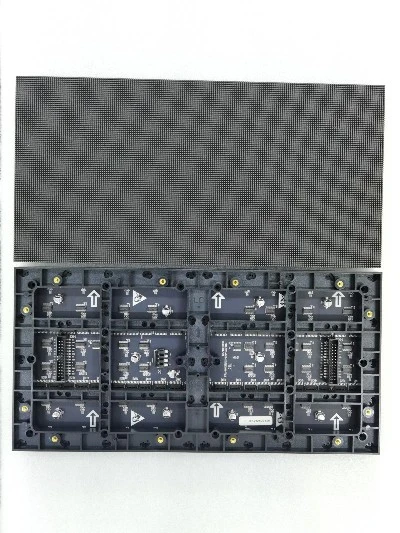
LED beads: packaging, attributes, identification and application scenarios
The packaging method, color selection, positive/negative electrode identification, and scene adaptation of LED chips directly determine the display's performance and installation quality.
1.Packaging method and color selection
Mainstream packaging types: through-hole, surface-mount, high-power, and COB LED chips, catering to diverse display requirements.
Rich color options: includes red, yellow-green, yellow, orange, blue, purple, pink, and white, to meet diverse display theme needs.
2.Methods for distinguishing between positive and negative electrodes
(1)Visual identification (no tools required)
Markings: The positive electrode surface usually has small dots or triangles, while the negative electrode has no markings.
Structure difference: The positive pin protrudes outward and is slightly longer than the negative pin; the negative pin is relatively shorter and has no protrusion.
(2)Tool testing (with a multimeter)
Steps: Set the multimeter to the resistance range, then use a test probe to test each of the LED's two pins.
Conclusion: The low resistance value of the pin is the positive pole, and the high resistance value of the pin is the negative pole, which can quickly solve the problem of identification.
3.Key Considerations for Brand Selection When choosing LED chip brands, multiple factors should be evaluated.
The key consideration is matching the product's performance requirements and usage scenarios to ensure the LED display's overall performance, stability, and lifespan, while avoiding display quality issues caused by incompatible brands.
4.Different application scenarios of packaged LED
(1)Direct-insert LED light beads
Structure limitation: Due to its own structure, the fitting distance is relatively wide.
Fit spacing: Primarily designed for P6-P20 intervals, including P8, P10, P16, P20, and smaller sizes down to P6.
Core Advantages: Exceptional waterproof performance, specifically engineered for outdoor displays to withstand extreme weather conditions.
(2)Surface-mount LED chips
Structural advantages: The structure is standardized, the metal frame can be flexibly adjusted, and the types are diverse.
Suitable pitch:outdoor cover P2.5-P13.33(including P3,P4,P5,P6,P8,P10,P13.33 );indoor cover P1.0-P10(including P1.25,P1.56,P1.667,P1.875,P2,P2.5,P3,P4,P4.75,P7.62 ).
Key features: Comprehensive coverage across all categories with diverse pixel pitches, meeting requirements from standard indoor/outdoor displays to high-precision small-pitch applications.